
Electronic Visit Verification (EVV): A Practical Guide for Service Business Operators
 By Bob Fitzjohn17 min read
Struggling with paper logs? Our guide to Electronic Visit Verification (EVV) helps you avoid 2026 claim denials and automate billing for operational clarity.

In this article
- Key Takeaways
- What is Electronic Visit Verification (EVV) in 2026?
- The 6 Pillars of a Compliant EVV System
- Why Modern Operators Choose EVV Beyond Compliance
- Implementation: How to Introduce EVV to Your Field Team
- Operational Excellence: The Team-Trak Approach to Verification
- Move Beyond Compliance to Operational Excellence
- Frequently Asked Questions
It’s 4:00 PM on a Friday. You’re staring at a stack of illegible paper logs while a client on the phone insists your team never showed up. You want to trust your staff and get them paid, but without proof, you're stuck in a stressful cycle of guesswork and disputes. This is exactly where Electronic Visit Verification or EVV moves from a regulatory burden to your most valuable operational tool. In 2026, with states like Minnesota and Michigan enforcing strict compliance thresholds and hard edits that automatically deny unverified claims, the stakes for your cash flow have never been higher.
I know the frustration of chasing down missing signatures and the dread of a Medicaid audit. You've likely felt that EVV is just more red tape, but it's actually the key to operational clarity. This guide will show you how to move beyond simple compliance to protect your reputation and automate your billing. We'll break down the 2026 federal requirements, explain how to avoid costly manual edits, and show you how to provide the proof of service that keeps your clients happy and your business growing.
Key Takeaways
- Understand how Electronic Visit Verification or EVV protects your business from 2026 "hard edit" claim denials by capturing six essential data points for every visit.
- Learn how to end the stressful Friday payroll scramble by replacing manual paper logs with automated, GPS-verified timesheets.
- Discover how "Proof of Service" reports can proactively settle client disputes and strengthen your reputation as a reliable provider.
- Get a step-by-step framework for introducing mobile verification apps to your field staff without causing friction or administrative weight.
- See how integrating verification data with tools like Xero and QuickBooks ensures your billing always matches the reality of the work performed in the field.
Table of Contents
What is Electronic Visit Verification (EVV) in 2026?
For decades, the service industry relied on "honesty-based" systems. You trusted your field staff to fill out paper logs accurately, and your clients trusted that those logs reflected reality. But trust doesn't stop a Medicaid audit or resolve a heated dispute over a missed visit. By 2026, the landscape has shifted entirely toward data-backed proof. Electronic Visit Verification (EVV) is a digital framework designed to capture real-time data at the point of service, ensuring that the right care or task is delivered to the right person at the right time and place.
This transition was largely driven by the 21st Century Cures Act. While it started as a federal mandate to reduce fraud and waste in Medicaid-funded programs, it has evolved into a gold standard for operational accountability. In 2026, state agencies have moved away from "soft edits" that allowed minor errors to pass. They now use "hard edits," which automatically deny claims if the digital verification data is missing or incomplete. For a business owner, EVV is no longer just a compliance checkbox; it's the heartbeat of your cash flow.
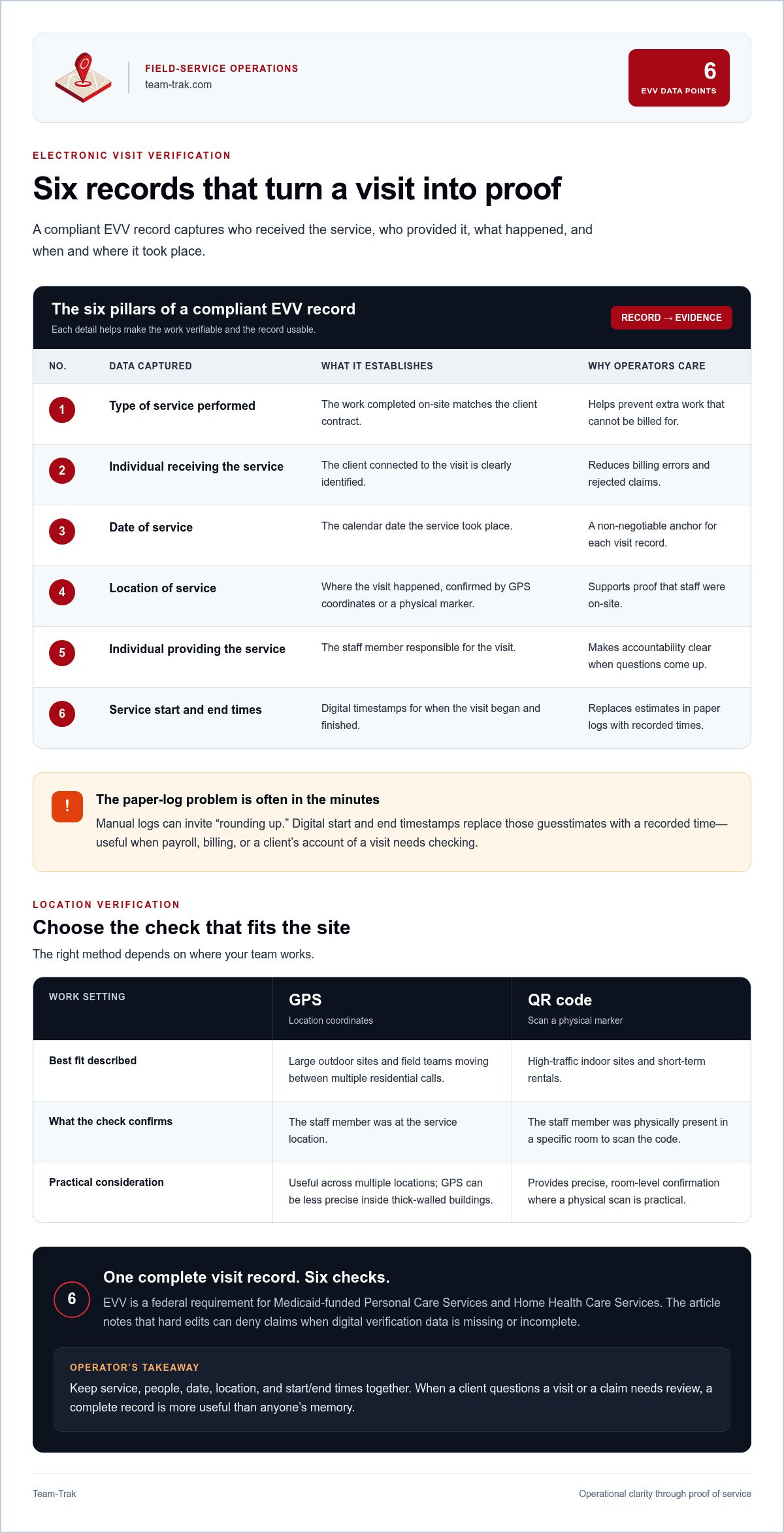
At its core, EVV is a digital system used to verify that a service or visit actually took place as scheduled. It replaces the "I think we were there" with "I know we were there." By capturing six specific data points, including the service type, the individual receiving the service, the date, the location, the provider, and the exact start and end times, you create an unshakeable record of work performed.
The Core Difference: Tracking vs. Verification
Many field staff hear the word "GPS" and immediately think of surveillance. They worry about being watched every second of the day. As an operator, it's vital to explain that EVV isn't about tracking; it's about verification. Tracking implies a lack of trust. Verification provides operational clarity.
When you use GPS verification, you aren't following a worker's every turn on the highway. Instead, you're creating a "verification shield." This shield protects your staff from false accusations by clients who claim a technician never showed up. It moves the conversation away from the "Where are they?" mindset and into a "Service is confirmed" reality. It gives your team the confidence that their hard work is documented and their paycheck is secure.
Who is EVV Mandatory For?
Currently, EVV is a federal requirement for all Medicaid-funded Personal Care Services (PCS) and Home Health Care Services (HHCS). If your revenue comes from these sources, compliance isn't optional. However, the circle is widening. We're seeing a significant trend where private insurance companies and even high-end commercial clients are demanding the same level of digital proof before they'll cut a check.
This has led to a surge in voluntary adoption. General service firms in industries like cleaning, HVAC, and construction are moving toward these systems to stand out from "old school" competitors. They realize that providing a client with a digital verification report builds immediate authority. It shows you run a professional, transparent operation that values precision over guesswork.
The 6 Pillars of a Compliant EVV System
If you’ve ever sat through a Medicaid audit, you know they don't care about your good intentions. They care about data. While the federal mandate sets the rules, these pillars are actually the building blocks of a well-run service business. A robust Electronic Visit Verification or EVV system must capture six specific pieces of information to be considered compliant. For an operator, these aren't just checkboxes; they're the evidence you need to get paid and protect your team.
- Type of service performed: This ensures the tasks completed on-site actually match the client contract. It prevents "scope creep" where staff do extra work you can't bill for.
- Individual receiving the service: Precise client identification stops billing errors before they happen. It’s the difference between a clean invoice and a rejected claim.
- Date of service: A simple but non-negotiable anchor for every record.
- Location of service: This confirms your staff was actually on-site using GPS coordinates or physical markers.
- Individual providing the service: This creates clear accountability. You’ll always know exactly who was in the building at any given time.
- Time the service begins and ends: Digital timestamps replace the "guesstimates" that plague paper logs.
Implementing these pillars doesn't have to be a headache. You can look at state-level EVV implementation examples to see how these requirements are structured in practice. If you have questions about how these pillars apply to your specific workflow, feel free to reach out to our team for a practical perspective.
Capturing Location: GPS vs. QR Codes
Choosing how to verify location depends on your environment. GPS verification is excellent for large outdoor sites or field service teams moving between multiple residential calls. However, if you manage high-traffic indoor sites or short-term rentals, QR code tracking is often the gold standard. It requires the staff member to be physically present in a specific room to scan a code, providing a level of precision that GPS sometimes misses inside thick-walled buildings.
Automating the Time Element
Manual logs have a "rounding up" problem. Whether it’s intentional or just a habit, staff often round a 42-minute visit up to an hour. Industry data suggests this habit costs service firms between 5% and 10% in annual labor costs. By using an automated timesheet module, you capture the exact minute a shift starts and ends. This reduces friction for your technicians, who no longer have to play a guessing game at the end of the week, and ensures your payroll reflects the true reality of the work performed.
Why Modern Operators Choose EVV Beyond Compliance
Modern operators don't just use Electronic Visit Verification or EVV because the government told them to. They use it because it ends the "Friday Afternoon Scramble." If you've ever spent your weekend chasing down a tech for a lost paper log or trying to decipher illegible handwriting just to run payroll, you know exactly what I mean. Digital verification turns that chaos into a calm, automated process. It allows you to move away from the disorder of manual systems and toward the precision of data-driven results.
Beyond payroll, it's about your reputation. I've had clients call up claiming a technician arrived 30 minutes late. Without data, it's your word against theirs, and usually, the customer wins. Having a "Proof of Service" report, powered by Electronic Visit Verification or EVV, changes that dynamic. You can send a verified arrival and departure time to a client before they even think about complaining. It shows you run a tight ship. It gives you operational visibility without the need to micromanage. You know exactly where your team is and that the work is getting done, all without calling them every hour.
Reducing Client Disputes with Hard Data
A common operational mistake is relying on a staff member’s memory during a billing dispute. Memory is subjective; GPS coordinates are not. Think of verified attendance as an insurance policy for your service reputation. When a dispute arises, you simply pull the record and show the facts. This level of transparency builds deep trust with your clients. They appreciate the professionalism, and you appreciate the lack of arguments. For more on how to handle these challenges, check out this guide on field service tracking software and the common myths surrounding it.
Simplifying Administrative Workflows
The real hero of this story is the administrative relief. When verification data flows directly into your workforce management scheduling, the manual audit tasks disappear. There is a specific kind of peace that comes from seeing a green "Verified" checkmark next to every completed shift. You don't have to call your team every hour to ask where they are. You can see it on your dashboard. This visibility reduces office overhead and allows you to focus on growing the business instead of just managing the friction of legacy systems. It’s about moving away from "tracking" and toward a culture of accountability that protects everyone involved.
Implementation: How to Introduce EVV to Your Field Team
Handing a new piece of software to a field team can feel like throwing a wrench into a moving engine. If you don't handle the rollout with care, you'll face resistance, "forgotten" logins, and a lot of unnecessary friction. Implementing Electronic Visit Verification or EVV is as much about managing people as it is about managing data. The goal is to make the transition feel like a relief, not a new administrative weight. You want your team to see this as a tool that supports them, not a system that polices them.
Follow these four steps to ensure a smooth transition:
- Step 1: Choose a "staff-first" mobile app. Don't force your team to carry extra hardware or clunky devices. Choose a system that works on the smartphones they already have in their pockets.
- Step 2: Lead with transparency. Be honest about why you're doing this. It isn't about surveillance; it's about safety, 2026 compliance, and making sure their pay is 100% accurate every single week.
- Step 3: Run a pilot program. Pick two or three of your most trusted, "tech-vocal" technicians. Let them test the system and provide feedback before you roll it out to the whole crew.
- Step 4: Connect verification to payroll. Nothing wins over a team faster than seeing their timesheets automatically populated. Show them that "Verified" status means their Friday check is guaranteed without the usual paperwork battle.
Overcoming the "Big Brother" Objection
Let's address the elephant in the room. Most staff hate the idea of being tracked. You need to explain that Electronic Visit Verification or EVV isn't a leash. It captures a GPS "ping" only at the moment of check-in and check-out to confirm the service location. It doesn't follow them to lunch or track them on their drive home. More importantly, it serves as their best defense. Staff buy-in happens the moment they realize verification ends "he-said-she-said" disputes. If a client claims a tech left early, the data proves otherwise. It protects their integrity and their paycheck.
Training for Operational Clarity
Clarity is the antidote to frustration. Use the mobile staff app to provide simple checklists that guide the visit. This ensures nothing is missed and the staff member feels supported. You must also set clear expectations for what a "Verified" visit looks like in your business. If a tech hits a "dead zone" with no signal, they need to know the app will store the data locally and sync once they're back in range. This removes the panic of technical glitches and keeps the focus on the work. If you're ready to see how this looks in practice for your specific team, book a quick walkthrough with us today.
Operational Excellence: The Team-Trak Approach to Verification
Team-Trak wasn't built by software engineers looking for a market to disrupt. It was built by operators who spent years managing field teams, running payroll, and dealing with the administrative weight of manual systems. We understand that Electronic Visit Verification or EVV is only useful if it actually fits into a busy technician's daily workflow without slowing them down. Our approach is grounded in the reality of the service industry. We focus on providing "proof of work" so you can stop guessing and start growing.
The core of our platform is the way it seamlessly links GPS verification to automated timesheets. When your staff arrives at a site and checks in via the mobile app, the system creates a digital anchor. There’s no need for them to write down start times or for you to chase them on a Friday afternoon. You also get the power of a Client Portal, which gives your customers total transparency. They can see when the work was completed without calling your office, which removes a massive layer of administrative overhead from your plate. Finally, we close the loop with direct integrations for Xero and QuickBooks. This turns those verified visits into accurate, paid invoices in a fraction of the time it takes to do it manually.
Built for Real-World Service Businesses
We built this platform to serve trades and field service companies who need more than just a dot on a map. Our "proof of service" philosophy beats generic "tech-first" tracking tools because we prioritize the business owner’s peace of mind. In my experience, the biggest headache isn't knowing where a tech is; it's proving they were there when a client questions a bill. By using a unified platform for scheduling, tracking, and billing, you create a culture of accountability. Your team knows their work is documented, and your clients know they’re getting exactly what they paid for. It’s a professional standard that sets you apart from "old school" competitors who still rely on scraps of paper.
Closing the Loop: From Check-in to Cash-in
One of the most common operational mistakes I see in growing firms is "billing leakage." This happens when 15 minutes here and a forgotten task there disappear because the paper trail went cold. Over a year, that leakage can cost you thousands in lost revenue. Electronic Visit Verification or EVV stops that leak immediately. When your billing is backed by verified data, you have the confidence to charge premium rates. You aren't just selling a service; you're selling a professional, transparent experience. This level of operational clarity is what allows you to scale without adding more office staff to manage the chaos. If you're ready to end the payroll scramble and protect your reputation, experience operational clarity with Team-Trak today.
Move Beyond Compliance to Operational Excellence
Running a service business is hard. You don't need the added stress of unverified hours, missing logs, or client disputes. Implementing Electronic Visit Verification or EVV is the most effective way to protect your reputation and your cash flow in 2026. By moving from paper to digital proof, you replace the Friday payroll scramble with a calm, automated process that ensures everyone gets paid correctly. You've seen how capturing the six core pillars of verification provides the operational clarity you need to scale without the administrative weight.
Team-Trak was built by operators who have lived through the same staffing and billing headaches you face every day. Our platform uses GPS and QR code verification to feed data directly into your automated timesheets and accounting tools like Xero and QuickBooks. It’s time to stop chasing paper and start focusing on the work that actually grows your business. You deserve the peace of mind that comes from knowing every visit is documented and every invoice is accurate.
End the payroll scramble and get proof of service with Team-Trak. You've built a great business; let's make sure you have the tools to protect it.
Frequently Asked Questions
Is Electronic Visit Verification (EVV) mandatory for my small business?
It depends entirely on your funding source and state regulations. Under the 21st Century Cures Act, EVV is mandatory for all Medicaid-funded Personal Care Services (PCS) and Home Health Care Services (HHCS). By 2026, states like Minnesota and Michigan have implemented strict "hard edits" that automatically deny non-compliant claims. If you're a private-pay service business, it isn't a legal mandate yet, but many operators use it to provide proof of service to demanding clients.
What happens if a staff member forgets to check in via the EVV app?
You'll need to perform a manual edit in your admin portal, but you should do this sparingly. In 2026, many state agencies require that at least 80% to 85% of visits be completed without manual intervention to remain compliant. Frequent manual edits are a red flag for auditors and can lead to corrective action plans. Treat these instances as training opportunities to ensure your team understands that a digital check-in is what guarantees their paycheck.
Does EVV track my employees’ locations throughout the entire day?
No, it only captures a location "ping" at the specific moments of check-in and check-out. Electronic Visit Verification or EVV is a tool for verification, not constant surveillance. It protects employee privacy by only recording coordinates when they are actively starting or ending a scheduled service. This provides the proof of work you need for billing without the invasive feel of 24/7 tracking.
Can I use EVV for businesses other than home healthcare, like cleaning or construction?
Yes, and it’s a smart move for any firm managing a field team. While the federal mandate focuses on healthcare, cleaning and construction companies use it to eliminate "time theft" and "rounding up" on paper logs. Providing a client with a verified report of exactly when your crew was on-site builds massive trust and helps you settle billing disputes before they turn into lost revenue.
How does EVV help with my Xero or QuickBooks accounting?
It eliminates the manual data entry that leads to "billing leakage" and payroll errors. The verified timestamps from the field flow directly into an automated timesheet module, which then syncs with your accounting software. This ensures that every invoice you send is backed by hard data. It turns the stressful Friday payroll scramble into a simple, two-minute review process.
Will my staff need expensive hardware to use an EVV system?
No, your team uses the smartphones they already carry in their pockets. A modern Electronic Visit Verification or EVV system works through a mobile staff app that handles GPS pings and QR code scans. You don't need to invest in specialized tracking devices or rugged tablets, which keeps your overhead low and makes it much easier to onboard new hires quickly.
What are the 6 data elements required for a compliant EVV system?
Federal law requires that every verified visit captures six specific points: the type of service performed, the individual receiving the service, the date of the service, the location of the service, the individual providing the service, and the exact start and end times. If your system misses any of these elements, it won't pass a 2026 Medicaid audit, and your claims will likely be denied.
How much time does it take to implement an EVV system for a field team?
You can have a pilot team up and running in less than 48 hours. The technical setup is the easy part; the real work is the human element of training your staff on the new workflow. I've found that starting with two or three trusted technicians allows you to work out any kinks before rolling it out to the rest of the company over a week or two.
Disclaimer
The information provided in this article is for general informational purposes only and reflects the opinions and experiences of the author. While every effort has been made to ensure accuracy, Team Trak makes no guarantees regarding completeness

Written by
Bob Fitzjohn
Founder of Team-Trak and serial entrepreneur with over 50 years’ experience building and scaling service businesses. Bob writes about workforce management, operational efficiency, automation, and the realities of running small businesses in today’s environment.


