
Reducing Invoice Disputes with Clients: A Guide to Operational Clarity
 By Bob Fitzjohn17 min read
Tired of fighting to get paid? Learn practical steps for reducing invoice disputes with clients through operational clarity and ironclad proof of work.

In this article
- Key Takeaways
- The High Cost of "He-Said-She-Said" in Service Billing
- Why Clients Dispute: Identifying the Operational Blind Spots
- Moving from "Trust Me" to "Proof of Work"
- 4 Steps to a Dispute-Proof Invoicing Workflow
- Ending the Billing Struggle with Team-Trak
- Reclaim Your Time and Protect Your Revenue
- Frequently Asked Questions
Did you know that 40% of all B2B payment delays have nothing to do with your client's bank balance? According to a 2026 AgentCollect report, these bottlenecks are actually the result of invoice disputes. It's a frustrating cycle that many service business owners know too well. You probably spend your Friday afternoons digging through old WhatsApp threads and messy paper timesheets just to prove you did the work you're billing for. It's exhausting, and it feels like your reputation is on the line every time a client questions an invoice.
We agree that you shouldn't have to fight to get paid for work you've already completed. This guide will show you how to end the "he-said-she-said" arguments for good. You'll learn how to protect your cash flow by reducing invoice disputes with clients through ironclad, data-backed proof of service. We're going to look at how moving from "trust me" systems to total operational clarity ensures faster payment cycles and gives you the peace of mind that your billing is 100% accurate every single time.
Key Takeaways
- Quantify the cost of "administrative friction" by uncovering the hidden hours wasted auditing paper logs and manual messages.
- Identify common operational blind spots, such as "ghost staff" concerns, that are critical to reducing invoice disputes with clients.
- Master the "Proof of Work" framework to protect your team from unfair accusations while providing clients with the visibility they demand.
- Implement a four-step workflow that uses QR codes and task checklists to document exactly when and how work was completed.
- Shift your business toward "operational realism" to ensure your billing is 100% accurate and your cash flow remains steady.
Table of Contents
The High Cost of "He-Said-She-Said" in Service Billing
In the world of field services, an invoice dispute is rarely about a simple typo. It's a fundamental mismatch between what the client expected and the work your team actually reported. Maybe the client thinks the cleaner left 20 minutes early, or perhaps they're convinced the technician didn't check the HVAC filters. Without proof, you're stuck in a "he-said-she-said" loop. This isn't just an annoyance; it's a high-cost operational failure. When you focus on reducing invoice disputes with clients, you aren't just fixing a billing error. You're fixing a visibility gap.
The true cost lies in what we call "Administrative Friction." Think about the hours you've lost on a Friday afternoon. You're scanning paper timesheets, scrolling through WhatsApp messages, and checking call logs to verify a single shift. It's a manual audit that drains your energy and your profits. Industry data from 2026 suggests that the average cost to resolve a single B2B dispute manually is between $300 and $500 once you factor in staff time and communication cycles. Beyond the numbers, constant questioning from clients kills staff morale. If your team is out there doing the hard work, it's demoralizing to have a client claim they were late or didn't finish a task. When your team feels like their word is never enough, they stop caring. In the 2026 service economy, the "Trust Me" billing model is dead.
The Cash Flow Bottleneck
A single £500 dispute does not just hold up that specific amount. In many cases, it stalls the entire £5,000 payment cycle. Clients often withhold the full payment until the smallest detail is resolved. This creates a dangerous ripple effect. Suddenly, you're scrambling to cover payroll or delaying payments to your own suppliers because of one unverified hour. I've seen businesses nearly collapse because their working capital was tied up in "pending" invoices that were 90% accurate but 10% disputed. Dispute-driven churn is the silent killer of service margins. It's the slow leak that drains your bank account while you're busy trying to prove you did your job.
Reputational Damage Beyond the Invoice
Every time you argue over minutes and hours, you're chipping away at long-term client trust. When billing feels "vague" or "estimated," clients start looking for reasons to leave. They don't want to feel like they're being overcharged, even if the work was perfect. This uncertainty often leads to negative reviews that can haunt your business for years. A professional invoice should serve as legal evidence for dispute resolution, but if it lacks data, it's just a piece of paper. By prioritizing the process of reducing invoice disputes with clients, you protect your brand from being labeled as disorganized or unreliable. For a deeper look at creating this level of transparency, you can explore ways to simplify your business operations and build a culture of accountability.
Why Clients Dispute: Identifying the Operational Blind Spots
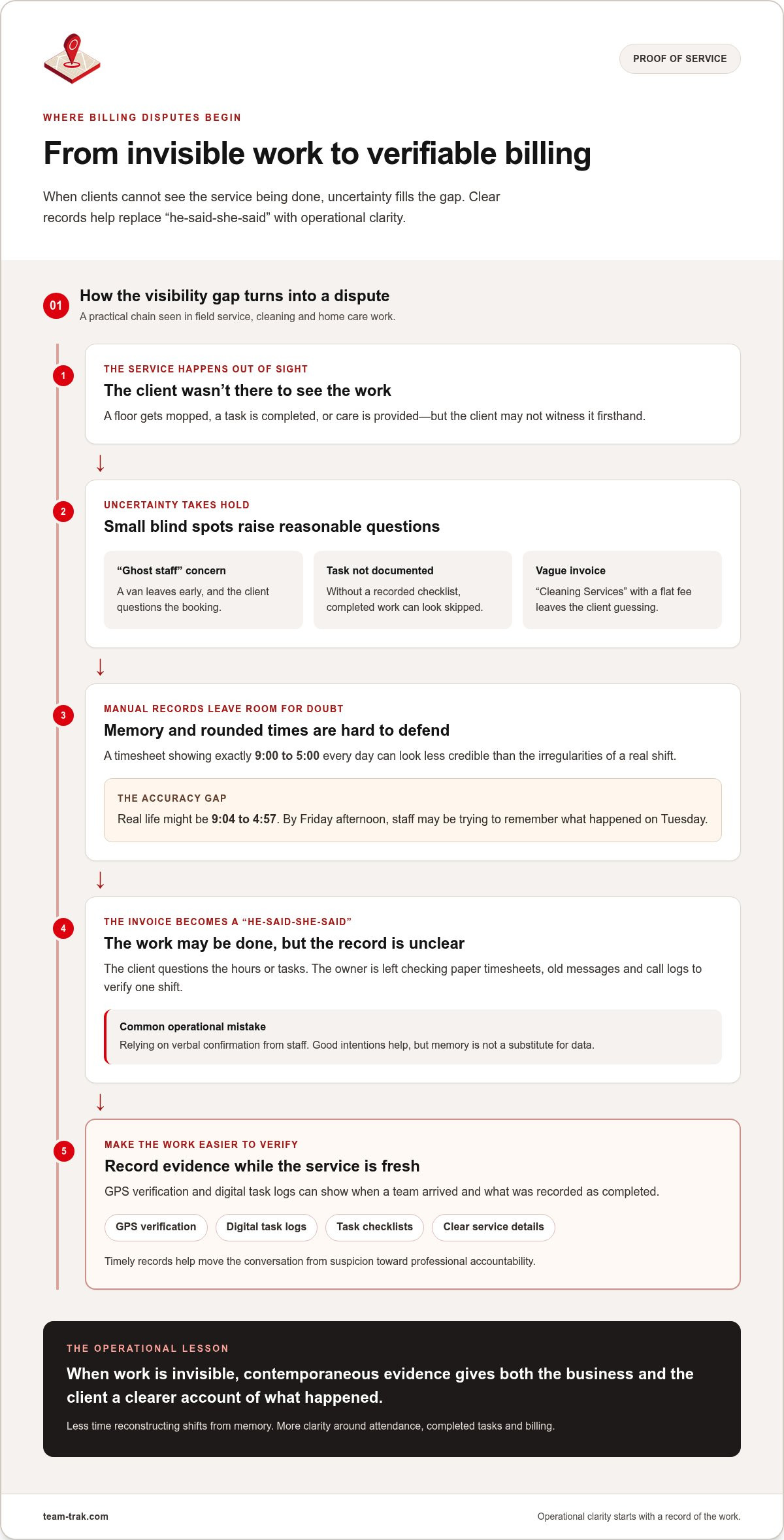
Clients don't usually push back on invoices because they're trying to be difficult. Most of the time, they dispute because they're uncertain. When you're managing a cleaning business or a home care agency, much of your work is "invisible." The client wasn't there to see the floor being mopped or the medication being administered. This lack of visibility creates operational blind spots that lead directly to friction. If you're serious about reducing invoice disputes with clients, you have to look at your business through their eyes.
One of the biggest triggers is the "Ghost Staff" fear. If a client happens to look out their window and sees your team's van pull away ten minutes early, they'll immediately question the entire four-hour booking. Another common issue is the "Incomplete Task" query. Maybe the work was done, but because the specific checklist wasn't followed or documented, the client assumes it was skipped. Then there's the "Vague Description" trap. An invoice that simply lists "Cleaning Services" with a flat fee is an invitation for a dispute. Clients want to see what they're paying for. In my experience, relying on verbal confirmation from staff is a massive mistake. Staff members have good intentions, but memory is a poor substitute for data.
The Accuracy Gap in Manual Timesheets
Manual timesheets are a trust-killer. When a client sees an invoice with perfectly rounded numbers, like exactly 9:00 to 5:00 every day, they get skeptical. Real life isn't that tidy. People arrive at 9:04 and leave at 4:57. This skepticism is compounded by "Friday afternoon memory." We've all seen staff members sitting in their vans at the end of the week, trying to remember what they did on Tuesday. This leads to errors that you then have to defend. Switching to automated timesheets removes the guesswork and builds instant credibility with your clients.
Lack of Real-Time Evidence
Waiting 30 days to send an invoice is a recipe for disaster. By the time the bill arrives, the client has forgotten how clean the office was or how helpful the technician was. They only see the dollar amount. Providing proof while the service is fresh in their mind changes the conversation. Using GPS verification and digital task logs allows you to present evidence that is impossible to argue with. It moves the relationship from a place of suspicion to a place of professional accountability. If you're tired of the constant back-and-forth, you might want to chat with our team about your operational challenges to see how data can protect your margins. This proactive approach is the most effective way of reducing invoice disputes with clients before they even start.
Moving from "Trust Me" to "Proof of Work"
Most advice on reducing invoice disputes with clients focuses on how to handle the conversation after the conflict starts. You're told to negotiate, find a middle ground, or offer a discount. But let's be honest. Compromise usually means you're walking away with less money for work your team actually did. The real solution isn't better negotiation; it's moving from a "trust me" model to a "proof of work" framework. This shift relies on three pillars: GPS verification, precise timestamps, and granular task completion data.
This isn't just about catching mistakes. It's about protecting your staff. In my years managing field teams, I've seen how damaging it is when a client accuses a hardworking technician of being late or skipping a task. Without data, it's your word against theirs. When you implement digital verification, you provide your team with a shield. It changes the power dynamic in your favor. Data ends arguments before they even start. If a client questions a bill, you don't have to scramble or get defensive. You simply point to the evidence. I've learned that transparency is the best defense against "bad faith" clients who use ambiguity to delay payments.
GPS Verification vs. Manual Reporting
Manual reporting is inherently flawed. Asking staff to "check in" via WhatsApp or text message is better than nothing, but it lacks authority. GPS location verification acts as a digital breadcrumb trail that cannot be faked or forgotten. It proves exactly where the worker was when the clock started and stopped. GPS data provides a neutral third party in any billing argument. It removes the human element of error and replaces it with cold, hard facts. This level of precision is essential for reducing invoice disputes with clients who are detail-oriented or skeptical of rounded numbers.
QR Codes: The Ultimate Attendance Receipt
For industries like cleaning or maintenance, physical presence is everything. QR code check-in creates a digital receipt that proves your staff was physically on-site. This is a game-changer for Airbnb hosts and short-term rental managers who often live far away from their properties. They need to know the turnover happened on time, even if they aren't there to see it. The "scan-to-start" workflow is a low-friction habit for staff. It takes two seconds, but it provides you with ironclad evidence that the job began exactly when you said it did. It turns a vague service into a documented event.
4 Steps to a Dispute-Proof Invoicing Workflow
Creating an ironclad billing process is about more than just sending a document. It's about building a chain of evidence that starts the moment your staff arrives on-site. If you're tired of the back-and-forth, you need a workflow that prioritizes reducing invoice disputes with clients through proactive documentation. Here are the four essential steps to take control of your revenue.
- Step 1: Digitize the Front End. Every shift should start with a digital anchor. Use QR codes or GPS verification to record the exact start time. This removes the possibility of "rounding up" and gives you a factual basis for every hour billed.
- Step 2: Use Granular Task Checklists. Don't just bill for "labor." Use digital checklists to document specific deliverables. When a client can see that "bins were emptied" or "safety checks were completed" at 2:15 PM, they have no room to claim the work wasn't done.
- Step 3: Audit Timesheets Daily. Don't wait until the end of the month to review your data. A quick daily audit allows you to catch anomalies, like a staff member forgetting to clock out, before that error ever reaches an invoice.
- Step 4: Provide a Client Portal. Transparency is the ultimate trust-builder. Give your customers a dedicated space where they can view their own service history and task completion data in real-time.
Integrating with Accounting Systems
Manual data entry is a major source of friction. Research from 2026 shows that 68% of accounts payable teams still rely on manual entry to key invoices into their systems. This is where errors creep in. By linking your field data directly to tools like Xero or QuickBooks, you ensure there is only "one version of the truth." Your operations and finance teams stay perfectly aligned. If you're currently evaluating your tech stack, check out our guide on choosing invoicing software for practical integration tips that work for real-world operators.
The Power of the Client Portal
Giving clients self-service access to their data significantly reduces inbound queries. Instead of calling you to ask if a technician showed up, they can simply log in and see the GPS timestamp themselves. This transforms your relationship from a "vendor" they have to watch into a "partner" they can trust. This level of visibility is particularly essential in high-stakes industries like construction and large-scale trades. In these sectors, where teams are large and billing is complex, a portal provides the clarity needed to keep projects moving. If you're ready to stop the "he-said-she-said" cycle, reach out to us to discuss a better workflow for your business. It's the most reliable way of reducing invoice disputes with clients while protecting your cash flow.
Ending the Billing Struggle with Team-Trak
Ending the billing struggle isn't about being more aggressive with your collections. It's about having better evidence. When you introduce Team-Trak into your workflow, you're adopting a level of "operational realism" that manual systems simply can't match. You no longer have to guess if a job was finished or if a staff member was actually on-site. You have the data right in front of you. This is the most effective path toward reducing invoice disputes with clients and protecting your hard-earned cash flow.
Our mobile staff app is designed with the field technician in mind. It's simple, fast, and removes the need for paper logs entirely. Your team can focus on their work while the app handles the verification. There's a profound peace of mind that comes from knowing every invoice you send is backed by ironclad timestamps and GPS data. We know that changing your systems can feel overwhelming. That's why we focus on a no-stress onboarding process. You don't need to commit to a massive financial investment to see immediate results. You can start small, digitize one team, and feel the relief as the administrative friction begins to melt away.
Built by Operators, for Operators
The Team-Trak philosophy is built on three pillars: visibility, accountability, and clarity. We didn't build this as a generic software project. We built it because we've lived the stress of payroll discrepancies and client arguments. You won't find "old school" hardware tracking devices here. Instead, we use smart mobile technology that your team already knows how to use. It's time to stop the guesswork. We invite you to simplify your operations and finally reclaim your Friday afternoons from the audit trail.
Next Steps for Your Business
Transitioning from paper to digital doesn't have to happen overnight. Start by implementing QR codes at your most "difficult" client sites first. You'll quickly see that "Proof of Service" becomes a massive competitive advantage in your marketing. When you can promise a client 100% billing accuracy backed by data, you stand out from every other provider in the industry. It moves the conversation from price to professional reliability. If you're ready to see how reducing invoice disputes with clients can transform your margins, it's time to take action. Book a demo or start your journey with Team-Trak today.
Reclaim Your Time and Protect Your Revenue
You've spent enough Friday afternoons auditing paper logs and arguing over minutes. Moving your business toward operational clarity isn't just about software; it's about building a culture of accountability. By replacing "trust me" systems with GPS-verified attendance and QR code check-ins, you provide your team with a shield and your clients with a digital receipt. This shift is the most reliable strategy for reducing invoice disputes with clients while ensuring your cash flow remains healthy.
When your field data flows seamlessly into Xero or QuickBooks, you eliminate the manual entry errors that trigger skepticism. You gain the freedom to focus on growth instead of administrative friction. It's time to trade the stress of disorganized paperwork for the relief of data-driven results. You've done the hard work; you deserve to get paid for it without the hassle. Take the first step toward a more professional, transparent operation today. Your team, your clients, and your bank balance will thank you for it.
Stop the billing arguments and start your Team-Trak journey today.
Frequently Asked Questions
How do I handle a client who refuses to pay even after I show them GPS data?
If a client refuses to pay despite ironclad GPS evidence, the issue has shifted from a dispute to a breach of contract. Your documentation serves as the primary evidence needed for formal collections or legal action. Having this data ensures you aren't guessing about the facts. It puts you in a position of strength where you can confidently stand by your invoice without offering unnecessary discounts or compromises.
Will using a tracking app make my employees feel like I don’t trust them?
Frame the mobile staff app as a tool for their protection rather than a surveillance device. Most field workers appreciate having a digital record that proves they were on-site and completed their tasks. It shields them from "ghost staff" accusations and unfair client complaints. When you explain that the system exists to validate their hard work and ensure they get paid accurately, the conversation moves from suspicion to professional support.
What is the best way to explain a new digital invoicing system to long-term clients?
Position the change as an upgrade to their service experience. Tell them you are moving to a "proof of work" model to provide total transparency and 100% billing accuracy. Most long-term clients will welcome the added visibility, especially if you grant them access to a client portal. Emphasize that this new level of operational clarity is designed to eliminate surprises and ensure they only pay for the exact services delivered.
Can I integrate my current accounting software with a field service management tool?
Yes, modern systems are designed to link directly with platforms like Xero and QuickBooks. This integration is a critical step in reducing invoice disputes with clients because it eliminates manual data entry errors. When your field attendance data flows straight into your billing tool, the numbers on the final invoice match the reality on the ground. This creates a single version of the truth that both operations and finance can rely on.
How much time does it actually take to manage automated timesheets compared to manual ones?
Managing automated timesheets takes a fraction of the time required for manual logs. Instead of spending hours every Friday cross-referencing paper sheets and messages, you simply review and approve digital entries. Most operators find they can cut their administrative workload by 70% or more. This reclaimed time allows you to focus on high-value tasks like business growth and staff training rather than chasing missing signatures and verifying vague timestamps.
What happens if my staff forgets to scan a QR code at the start of a shift?
The system allows for manual overrides by managers to ensure the record remains accurate. While the goal is a "scan-to-start" habit, real life happens. You can manually adjust the entry based on other data points, like GPS location or verbal confirmation, and add a note to the log. Consistently reviewing these anomalies helps you identify training opportunities so your team eventually reaches a point of total digital compliance.
Is GPS verification accurate enough to use as legal evidence in a dispute?
GPS verification is highly reliable and widely accepted as a standard for operational proof. It provides a neutral, third-party record of exactly where a worker was at a specific time. Using this data is a powerful tactic for reducing invoice disputes with clients because it is difficult to challenge in a legal or mediation setting. It moves the argument away from subjective memory and replaces it with verifiable, objective coordinates.
Do I need expensive hardware to start tracking staff attendance and work quality?
No, you don't need to invest in any specialized tracking devices or expensive hardware. Modern field service management relies on the smartphones your staff already carry. By using a mobile app and QR codes, you can achieve professional-grade visibility without the high upfront costs. This low-friction approach makes it easy to transition from "old school" paper systems to a digital workflow that provides immediate operational clarity for your business.
Disclaimer
The information provided in this article is for general informational purposes only and reflects the opinions and experiences of the author. While every effort has been made to ensure accuracy, Team Trak makes no guarantees regarding completeness

Written by
Bob Fitzjohn
Founder of Team-Trak and serial entrepreneur with over 50 years’ experience building and scaling service businesses. Bob writes about workforce management, operational efficiency, automation, and the realities of running small businesses in today’s environment.


