
It is Friday afternoon and you are staring at a stack of illegible handwritten timesheets while a client on the phone disputes a three-hour labor charge from last Tuesday. You know the work was done, but you lack the digital trail to prove it. Most service owners started their business to master a craft, not to become a full-time private investigator chasing staff for updates or arguing over GPS coordinates. This administrative friction does more than just eat your margins. It drains your energy and keeps you from growing.
Effective field service workforce management is not about micromanagement. It is about eliminating the manual chaos that keeps you chained to your desk. According to 2026 industry reports, 74% of field service leaders say meeting rising customer expectations is their biggest hurdle. This guide will show you how to move from administrative friction to operational clarity using a field service management application built for real-world owners. You will discover how to automate your timesheets, verify staff locations, and provide the proof of service that ends client disputes for good. We will explore how to build a system where accountability is baked into the workflow, giving you the freedom to lead your business with confidence.
Key Takeaways
- Move beyond the “trust and hope” management model by implementing a system that prioritizes verifiable proof of work and real-time operational clarity.
- Identify why manual coordination tools like WhatsApp and spreadsheets fail during growth, and how dedicated field service workforce management software provides a more reliable, scalable alternative.
- Discover a low-stress implementation roadmap designed to overcome staff resistance by focusing on ease of use and reduced administrative friction.
- Learn how to leverage professional tools like client portals to eliminate billing disputes and win larger contracts through total service transparency.
The Administrative Burden: Why Trust and Hope Fails Modern Service Teams
Most service business owners start with what I call the “Trust and Hope” model. You hire good people, you hand them a schedule, and you hope they show up. You trust that the timesheets they submit on Friday afternoon are accurate. Trust is essential for a healthy culture, but it isn’t a management system. When your business grows from three people to twenty, relying on hope leads to expensive friction. This is where Field service management (FSM) becomes a necessity rather than a luxury. It transforms your role from a private investigator chasing updates into an operator with total clarity.
A dedicated field service management application isn’t just a digital version of a paper form. It is a system for operational clarity and undeniable proof of work. Without it, you are likely making the common mistake of relying on verbal confirmations for client billing. If you can’t prove exactly when your team arrived and what they did, you are vulnerable to disputes that drain your time and damage your reputation. Mastering these tools is the first step toward scaling without the stress, as detailed in our guide on Mastering Field Workforce Management Software in 2026.
The Hidden Cost of Administrative Friction
Administrative friction is a silent profit killer. Manual data entry and reconciling paper timesheets often eat between five and ten hours of an owner’s week. Think about the “Friday afternoon scramble.” You’re likely cross-referencing WhatsApp messages, GPS pings, and handwritten notes just to run payroll. This chaos leads to “billing leakages.” When a technician forgets to log a 20-minute site visit or a specific task, that revenue vanishes. For a small team, these unlogged minutes can add up to thousands of dollars in lost profit every year.
Why Proof of Service is Your Best Retention Strategy
Data-backed reports prevent client disputes before they even happen. In the cleaning or home care industries, clients often forget the details of a visit by the time the invoice arrives. When you provide an automated report with GPS-verified check-in times and completed checklists, you aren’t just a vendor anymore. You become a transparent partner. This level of field service workforce management professionalizes your business instantly. It reduces the emotional weight of managing remote teams because you no longer have to wonder if the work was done. You have the data to prove it, giving you back your peace of mind.
Essential Features of a 2026 Field Service Management Application
A basic task list is little more than a digital sticky note. It tells your team what to do, but it doesn’t tell you if they actually did it. In 2026, the standard for field service workforce management has shifted toward “Proof of Work.” This means moving beyond simple checklists and toward a system that captures hard evidence of service. For the modern operator, the goal is to create a workflow where data is collected naturally in the field, synced in real-time, and ready for invoicing before the technician even leaves the site. It reflects reality. It is that simple.
Staff adoption is the biggest hurdle for any new tool. If an application is clunky or feels like a burden, your team will revert to paper. Modern applications must be mobile-first. They should empower staff to handle their entire day from their phone, from viewing smart schedules to checking off tasks. When this data syncs instantly, your back office can stop playing catch-up. You can link your operations directly to tools like Xero or QuickBooks, ensuring that your billing is as fast as your service. If you’re ready to see how this works for your specific industry, you can reach out to our team for a walkthrough.
GPS Verification vs. Passive Tracking
There is a massive difference between “stalking” your employees and verifying their arrival at a job site. Passive tracking, where you monitor a vehicle’s every turn, often creates resentment. GPS location verification is different. It only captures a location at the moment of check-in and check-out. This protects your business during client audits by providing a timestamped record of presence. GPS verification is a tool for staff protection and client trust that ensures everyone is on the same page without hovering over their shoulders.
QR Codes: The Simple Fix for Attendance Disputes
One of the most reliable ways to solve attendance issues is through QR code tracking. Think of it as a physical handshake between your staff and the client’s property. By placing a QR code at the job site, you require the staff member to be physically present to check in. This creates an immutable log that is much harder to dispute than a manual entry on a spreadsheet. It effectively eliminates “buddy punching” or the temptation for early departures. For the business owner, the relief comes from knowing that your payroll reflects reality, not just a best guess. It professionalizes your operation and gives you the visibility you need to manage remote teams effectively. Trust but verify.
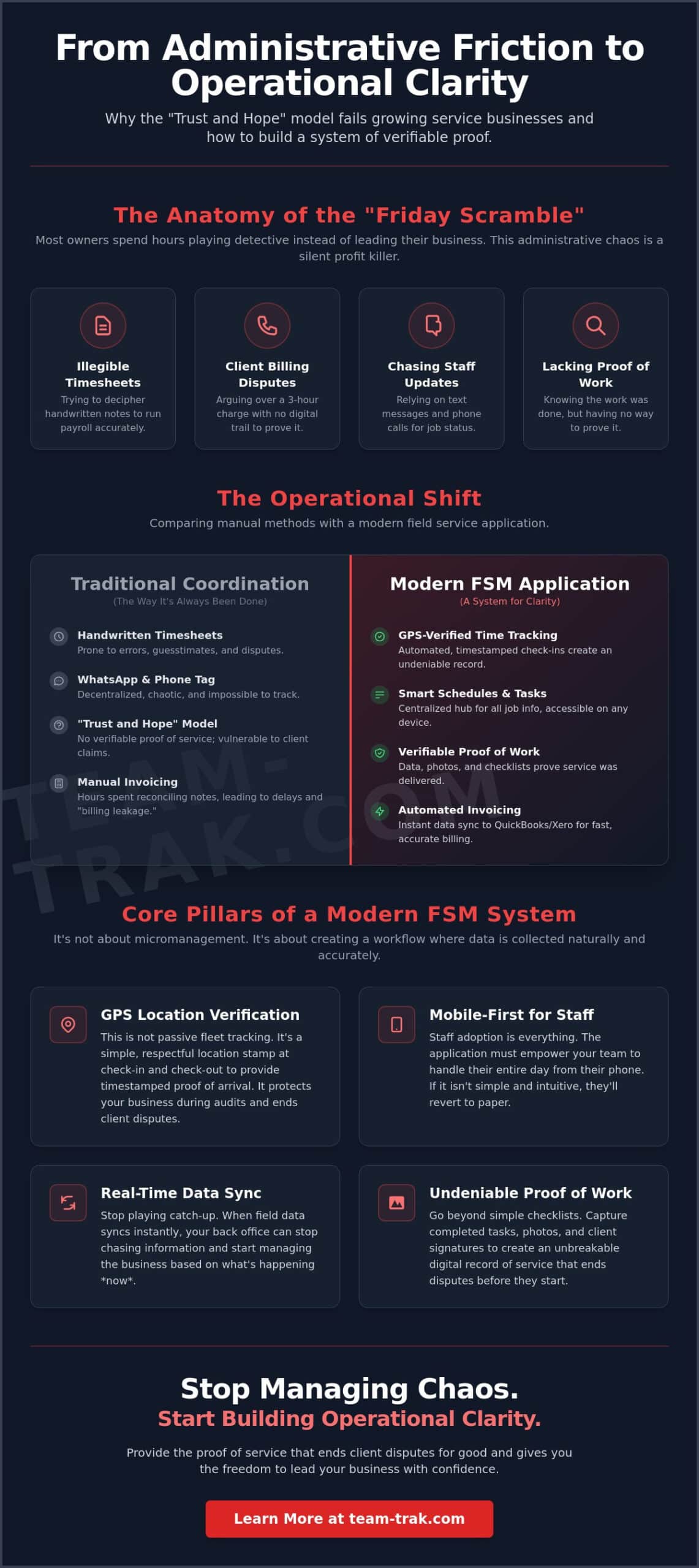
Comparing Digital Applications vs. Traditional Coordination Methods
Every service owner remembers the “scrappy” phase. In the beginning, managing two or three technicians via a WhatsApp group and a legal pad feels efficient. It is fast, free, and familiar. However, as your team grows, these informal methods begin to buckle under the weight of real-world complexity. The transition to professional field service workforce management is not just about adopting new tech. It is about moving from a state of reactive firefighting to a state of operational realism. You can read more about the 5 Practical Benefits of Field Service Management Software to see how this shift impacts your bottom line.
The Spreadsheet Trap: Why Manual Systems Fail at Scale
The “Spreadsheet Trap” is a common operational hurdle. It starts when you move your paper notes into a master Excel or Google Sheet. For a while, it works. Then, a staff member forgets to text their hours. A manager accidentally deletes a cell formula. Suddenly, your payroll is wrong, and your trust with the team is fractured. Manual systems create information silos where critical job details are trapped in individual text threads or someone’s memory. This leads to massive human error that automated timesheets simply eliminate. While WhatsApp is “free,” the cost of staff confusion and lost billable hours is incredibly high. If your managers spend half their day asking “Are you there yet?” you aren’t saving money. You’re wasting it.
Integration with Accounting: Closing the Loop
The true power of a digital application lies in closing the loop between the field and the front office. When your field operations link directly to Xero or QuickBooks, the entire business rhythm changes. In the old model, a job finished on Tuesday might not be invoiced until the following Monday after you’ve chased down the paperwork. With a dedicated application, the transition from “Job Finished” to “Invoice Sent” happens in seconds. This drastically reduces your “days sales outstanding” (DSO). Better cash flow means you can stop worrying about making payroll and start focusing on winning the next big contract. By professionalizing this workflow, you provide your clients with a level of service that manual systems can never match. It is the difference between being a local contractor and a scalable service leader.
Step-by-Step: Implementing Field Software Without the Operational Stress
Implementing a new field service workforce management system doesn’t have to be a headache. Most owners fear that “going digital” will lead to a mutiny or a week of lost productivity. It shouldn’t. The key is a low-friction roadmap that prioritizes your relief. Start by identifying your biggest pain point. Is it payroll? Is it client disputes? Fix that first. The goal is to move from chaos to a steady rhythm without breaking what already works. You don’t need to flip every switch on day one. You just need to start moving toward clarity.
Overcoming Staff Resistance Through Transparency
Framing is everything. If you tell your team you’re “tracking” them, they’ll push back. Instead, frame the application as their best defense against unfair complaints. In industries like cleaning or managing short-term rental and airbnb hosts, a client might claim a room wasn’t serviced or a technician arrived late. The app provides the timestamped proof that your staff did exactly what they were paid for. It protects their reputation as much as yours. I always recommend a “soft launch” period. Run the app alongside your old system for seven days. This builds confidence and lets everyone see the benefits before the paper forms disappear for good. It’s about building a culture of accountability, not a culture of surveillance.
Setting Up Task Checklists for Quality Control
Effective field service workforce management relies on clear expectations. Use task checklists to ensure the job is done right the first time, every time. For those in construction or heavy trades, these checklists can include safety compliance and specific site requirements that are easy to overlook. The real hero here is the photo upload feature. A “Proof of Service” photo attached to a checklist item ends the “he-said-she-said” scenarios that drain your energy and damage your margins. You can see the work, the client can see the work, and everyone can move on. If you want a hand setting up your first workflow or building your custom checklists, get in touch with us to start your implementation today. We’ve helped hundreds of operators make this transition without the stress.
Beyond Tracking: Using Team-Trak for Total Operational Clarity
Adopting a new system is about more than just software. It is about choosing a partner that understands the daily friction of managing people and payroll. Team-Trak isn’t just a vendor; we are a partner in helping you achieve “Operational Calm.” By simplifying operations, you move away from the noise of manual coordination and toward a state where your business runs smoothly even when you aren’t looking. This shift is the core of modern field service workforce management. For a deeper look at how this fits into your long-term strategy, check out our guide on All-in-One Field Service Software. It reflects the reality of running a service firm in 2026.
Empowering Clients with Portal Access
Transparency is a competitive advantage. When you give your clients access to a dedicated portal, you professionalize your business instantly. They can log in to see their service history, view completed checklists, and confirm check-in times without calling your office. This drastically reduces the “where is my technician?” phone calls that interrupt your day, especially during peak hours. In industries like home care or commercial cleaning, this level of visibility builds immense trust. It transforms you from a replaceable contractor into a high-value partner. High-value clients are looking for this level of accountability. They want to know that the money they spend is being used efficiently, and the portal provides that evidence 24/7. It makes it far easier to win and retain long-term contracts that provide stability for your team.
From Field Work to Automated Business Intelligence
The data your team collects in the field is more than just proof of work. It is business intelligence that most small firms never utilize. Most operators run their business on a “gut feeling” about which jobs are profitable and which ones are losing money. When you see exactly how long certain tasks take or which sites consistently run over time, you stop guessing and start leading. This is the transition from “reactive” firefighting to “proactive” management. Instead of wondering why your margins are thin on a Friday night, you have the hard data to fix the problem on Monday morning. You gain the actual freedom to work on the business rather than being stuck in it. It’s about moving from a state of exhaustion to a state of control where you finally have the time to look at growth instead of just survival.
True operational clarity comes when your software works for you, not the other way around. By integrating field service workforce management into your daily rhythm, you eliminate the administrative noise that keeps you from scaling. You build a business that is respected by staff and trusted by clients. The relief of knowing your team is where they should be, doing what they should be doing, is the ultimate reward for any service owner. It is time to stop chasing updates and start building a legacy of excellence. If you’re ready to leave the chaos behind, Experience Operational Calm with Team-Trak and take control of your future today.
Take Control and Build Your Operational Legacy
Transitioning from the friction of manual timesheets to a streamlined digital system isn’t just a technical upgrade. It’s a fundamental shift in how you lead your team. By moving away from “trust and hope” and toward verifiable proof of work, you reclaim the hours lost to administrative firefighting. You’ve seen how modern tools solve the “spreadsheet trap” and how a thoughtful implementation can actually protect your staff rather than alienate them. It’s about building a culture where everyone knows exactly what is expected and when the job is done.
Effective field service workforce management is the bridge between a business that survives and one that scales. With GPS-verified attendance for total accountability, QR code check-in functionality for proof of service, and direct integration with Xero and QuickBooks, you finally have the data to make proactive decisions. This is the path to operational calm. The goal is to move from exhaustion to excellence. It’s time to stop chasing updates and start focusing on the high-level strategy that only you can provide.
Start your journey toward operational clarity with Team-Trak today. You deserve the peace of mind that comes with knowing the work is being done right. Let’s get to work.
Frequently Asked Questions
What is a field service management application?
A field service management application is a digital system designed to provide operational clarity and “proof of work” for mobile teams. It replaces manual paper trails with automated tools for scheduling, time tracking, and task management. By centralizing these functions, it helps business owners see exactly what is happening in the field without needing to be physically present at every job site. It is a tool for accountability and owner freedom.
Will my staff feel like I am micromanaging them with a field app?
Not if you frame the application as a tool for their protection. Most staff resistance fades when they realize the app provides an immutable record of their hard work. It protects them from unfair client claims about arrival times or work quality. When you move to professional field service workforce management, you’re building a culture where good work is documented and recognized, rather than just watched.
How does GPS verification help reduce client disputes?
GPS verification provides timestamped proof that a staff member was physically present at the job site during the reported hours. When a client questions an invoice, you can provide hard data showing the exact check-in and check-out coordinates. This evidence ends “he-said-she-said” arguments instantly. It turns a potential conflict into a simple review of the facts, preserving your professional reputation and your profit margins.
Can a field service management app integrate with Xero or QuickBooks?
Yes, the best platforms offer direct integration with online accounting systems like Xero and QuickBooks. This link allows you to push verified timesheet data directly into your payroll or invoicing modules. It eliminates the need for manual data entry on Friday afternoons. You can move from a finished job to a sent invoice in seconds, which significantly improves your business cash flow and reduces administrative errors.
Is a mobile staff app difficult for non-technical workers to use?
No, modern apps are designed to be mobile-first and highly intuitive. Most workers who can use a smartphone to send a text can master a field app within minutes. The interface usually focuses on simple check-in buttons and easy checklists. By removing the complexity of paper forms, you actually make the daily routine easier for your team. It replaces confusion with a clear, step-by-step workflow.
How much time can I expect to save on admin by using an FSM application?
Many operators report saving between five and ten hours every week on manual administrative tasks. You stop chasing staff for missing timesheets and stop manually cross-referencing GPS pings or WhatsApp messages. This time can be reinvested into growing the business or simply enjoying a weekend without the stress of pending payroll. It is about reclaiming your role as an owner rather than an administrator.
Does Team-Trak offer a client portal for my customers?
Yes, Team-Trak includes a Client Portal that allows your customers to log in and view their own service history. This transparency builds immense trust with high-value clients and reduces the volume of “where is my technician?” phone calls. Providing this level of professional visibility can be the deciding factor when you are bidding on larger, more lucrative service contracts. It professionalizes your brand from day one.
What happens if my staff work in areas with poor mobile signal?
Modern applications are built to handle real-world conditions, including poor mobile reception. If a staff member checks in while offline, the app stores the timestamped data locally on their device. Once they return to an area with a signal, the data syncs automatically with the main platform. This ensures that your field service workforce management records remain accurate and complete, regardless of the job site’s location or connectivity issues.

Disclaimer
The information provided in this article is for general informational purposes only and reflects the opinions and experiences of the author. While every effort has been made to ensure accuracy, Team Trak makes no guarantees regarding completeness