
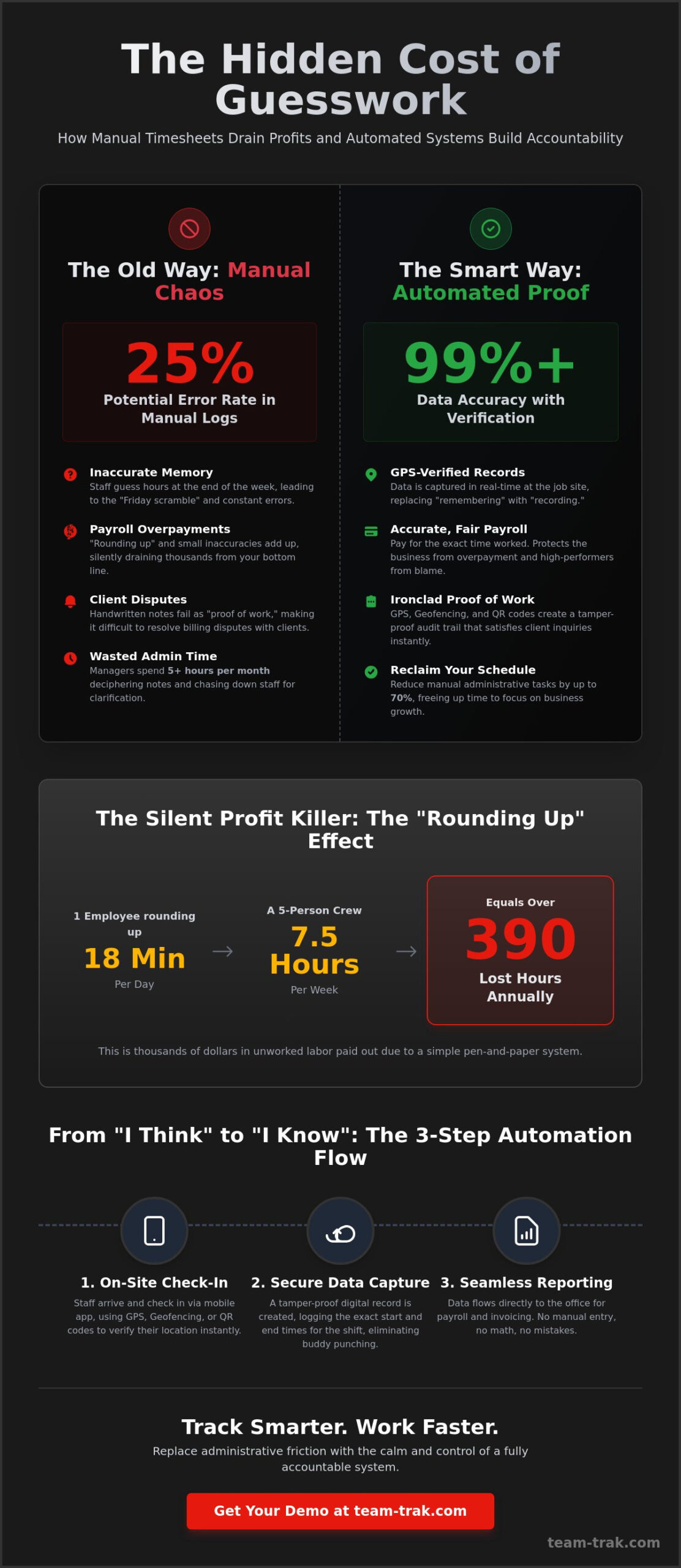
Manual timesheets filled out at the end of the week carry an error rate of up to 25%. You know the Friday afternoon scramble well. It’s a stressful cycle of chasing down field staff for hours they can’t quite remember. This guesswork often leads to payroll overpayments and frustrating client disputes over billable time on-site. You’re likely spending five or more hours every month just resolving these avoidable payroll issues.
We understand that you’re tired of the administrative friction and the messy paper trail. It’s time to replace manual chaos with automated timesheets to reclaim your time and ensure operational accountability. You deserve a system that provides a sense of calm and total control over your field operations. In this guide, we’ll explore how GPS verification and mobile check-ins provide the proof of work your clients demand while delivering instant, reliable data for your team. Track Smarter. Work Faster.
Key Takeaways
- Eliminate the stress of the Friday afternoon scramble by capturing precise attendance data directly at the source.
- Discover how automated timesheets leverage GPS verification to provide instant, reliable records without any manual data entry.
- Turn tracking into a tool for team fairness by protecting high-performing staff from being blamed for others’ inaccuracies.
- Boost your bottom line and client retention by reducing unbilled hours through transparent, real-time operational reporting.
- Reclaim your schedule and replace administrative friction with a streamlined process that keeps your field operations accountable.
The Hidden Cost of Manual Guesswork: Why Paper Timesheets Drain Your Profits
Every Friday, the same chaos unfolds in your office. You’re chasing crews. They’re staring at the ceiling, trying to remember if they arrived at the Smith job at 8:00 AM or 8:30 AM last Monday. This is the “Friday afternoon scramble.” It turns your office into a high-stress zone and your payroll into a guessing game. When your team relies on memory, accuracy is the first thing to go.
Historically, the standard method for recording time involved paper logs or manual spreadsheets. These systems are reactive. In contrast, automated timesheets capture attendance data at the source. The system logs the start and end of the workday exactly when it happens, without any manual entry from the staff. This shift from “remembering” to “recording” is what saves your profit margins.
The impact of “rounding up” is a silent killer for labor costs. If a technician finishes at 4:42 PM but writes down 5:00 PM, that’s 18 minutes of unearned pay. Across a crew of five, five days a week, those small gaps add up to over 390 hours of unworked labor annually. For a service business, that’s thousands of dollars in profit simply vanishing because of a pen and paper. Dedicated time tracking software for service companies can recover 15% to 40% of billable hours that typically slip through the cracks of manual entry.
The Reality of Administrative Friction
Administrative friction is the cumulative weight of manual data correction that slows your business to a crawl. Deciphering coffee-stained notes and messy handwriting isn’t just annoying; it’s expensive. These manual systems create a “trust gap” between management and field staff. When you have to question a timesheet, it feels like an accusation. Payroll disputes then force you to spend hours re-verifying work that happened days ago, pulling you away from high-value tasks.
Inaccuracy vs. Accountability
“Roughly right” is never enough for a profitable service business. There’s a big difference between intentional time theft and accidental memory lapses, but the result for your bank account is the same. Manual systems fail to provide the “proof of work” that modern clients demand. If a client disputes an invoice, a handwritten note won’t save you. Switching to automated timesheets replaces “I think I was there” with “I know I was there,” providing the accountability your business needs to thrive. Track Smarter. Work Faster.
How Automated Timesheets Work: From GPS Verification to Instant Data
Modern field operations don’t have time for the “he-said, she-said” of manual logs. The transition to automated timesheets starts with a simple digital handshake between the worker and the job site. Instead of writing down a guess at the end of the day, staff check in via a mobile staff app as soon as they arrive. The system immediately verifies their location and generates a precise record. It’s a shift from merely tracking time to verifying attendance in real-time.
This process ensures your business stays compliant with federal record-keeping requirements without adding a heavy administrative burden. When a worker scans a code on-site, it creates a physical link to the location. This eliminates the possibility of “buddy punching” or checking in from the truck three blocks away. You get clean data. Your staff gets a system that proves their hard work. It’s a win for everyone involved.
The Mechanics of Modern Attendance
The core of this system relies on GPS location verification to anchor every entry to a specific coordinate. Geofencing acts as a digital boundary, preventing off-site check-ins before the team actually reaches the client. To add another layer of certainty, QR code tracking acts as a digital timestamp that proves your team reached the correct location at the exact time they claimed. This setup replaces the unreliable paper logbook with a tamper-proof, high-integrity stream of information.
Seamless Integration with Payroll
Once the data is captured in the field, it flows directly to the office. There’s no re-typing, no squinting at messy notes, and no manual math. Automated systems handle the heavy lifting by calculating breaks, overtime, and travel time based on your specific rules. This creates a single source of truth for every shift worked. Companies using these automation tools report reducing manual tasks by 70%, allowing managers to focus on growth rather than data entry. If you want to see how this fits your specific workflow, reach out to our team today. Track Smarter. Work Faster.
Overcoming Implementation Friction: Moving Your Team to Digital Tracking
Introducing new technology to a field crew often triggers a specific fear: the “Big Brother” effect. Many workers worry about being watched every second of their shift. However, recent research on automated time tracking solutions shows that these systems actually increase employee satisfaction by ensuring total payroll accuracy. You aren’t installing spyware. You’re installing a shield for your honest workers. Automated timesheets protect the person who arrives on time from being grouped with the person who consistently shows up twenty minutes late. By simplifying operations, you remove the burden of proof from the employee and place it on the system.
Transitioning to automated timesheets for service businesses doesn’t have to be a battle. The key is to frame the change as a benefit for the team. When your staff realizes that their hours are recorded perfectly and their paychecks will be right every single time, the resistance fades. It’s about replacing the stress of memory with the relief of precision. Track Smarter. Work Faster.
Framing Automation as Accountability
Visibility is a two-way street. When a worker has a question about their paycheck, you don’t have to dig through a shoebox of coffee-stained receipts. You have the data. This transparency resolves pay disputes instantly and fairly. By linking smart schedules with real-time tracking, you reduce worker confusion about where they should be and when. It’s about clarity, not surveillance. Honest workers thrive when the rules are clear and the data is objective.
Training and Rollout Strategies
Don’t flip the switch for the whole company overnight. Start with a “Pilot Team” of three to five trusted staff members. Let them prove to the rest of the crew that the app is actually easier than a pen and paper. The gold standard for any field app is the “one-tap” check-in. If the process takes more than five seconds, it’s too complicated. Remove the fear of “Big Brother” by being transparent about your data policies. Show them that the system only logs location at the moment of check-in, not during their lunch break or after they leave the site. This builds a culture of high-trust accountability. If you’re ready to stop the pushback and start the progress, get started with a custom walkthrough today.
Building a High-Trust Operation: The Long-Term ROI of Automation
High-trust operations aren’t built on handshakes alone; they’re built on verifiable data. Transitioning to automated timesheets marks the specific moment a simple crew evolves into a professional, scalable business. While the immediate relief of a quiet Friday afternoon is valuable, the long-term return on investment comes from total visibility. When you stop guessing, you start growing. You move from defensive management to offensive strategy.
One of the most significant profit drivers is the drastic reduction in “unbilled hours.” Inaccurate logs often result in work that never makes it onto an invoice. By capturing every minute on-site, you protect your bottom line from the slow leak of forgotten tasks. For trades and field service companies, this data is also a competitive weapon. You can analyze exactly how long specific jobs take, allowing you to bid more accurately on future contracts and win more work with confidence. A strong foundation in workforce management scheduling ensures that accurate time data translates directly into smarter staffing decisions and more profitable operations.
Visibility for Your Clients
Providing “proof of work” eliminates invoice queries before they even reach your inbox. When a client can see a digital record of exactly when your team arrived and departed, the “trust gap” disappears. This level of transparency builds a reputation for reliability that keeps clients coming back. If you want to dive deeper into how digital access transforms the customer experience, check out our Client Portal Software Guide. Professionalism is about showing your work, not just doing it.
Scaling Without the Admin Burden
Manual systems don’t just slow you down; they eventually break. A system that works for five people will collapse when you grow to 50 staff. Scaling your business requires a foundation that doesn’t demand more of your personal time as you add more crews. Automated timesheets allow you to double your workforce without doubling your office staff or your stress levels. You free up management time to focus on high-level growth rather than chasing paper. It’s time to leave the chaos behind and embrace a precise, reliable future. Ready to track smarter and work faster? Get started with Team-Trak today.
Take Control of Your Field Operations
You’ve seen how manual systems drain your profits and create unnecessary friction every Friday afternoon. By switching to automated timesheets, you eliminate the 25% error rate typical of handwritten logs. You replace memory lapses with GPS-verified attendance and secure QR code check-in functionality. This is the moment your operation moves from reactive chaos to proactive growth. You’re no longer just managing a crew; you’re leading a professional, data-driven business.
Your data now flows directly from the job site to your office. With a direct link to online accounting systems, you remove the risk of manual re-typing and speed up your entire billing cycle. This shift allows you to reclaim five or more hours every month previously lost to payroll disputes. It’s time to trade administrative stress for the relief of precise, reliable pay information. Your team deserves a system that rewards their hard work with absolute accuracy.
For a step-by-step walkthrough of getting started, our guide on how to use automated timesheets for service businesses to simplify your admin covers everything you need to make the transition with confidence.
Track Smarter. Work Faster. Start your Team-Trak trial today.
The future of your workforce management is smart, effortless, and ready for you to take the lead. No credit card needed. No stress. Just the control you need to help your business thrive.
Frequently Asked Questions
What are automated timesheets and how do they differ from digital timers?
Automated timesheets capture attendance data at the source without requiring manual input from your team. Unlike digital timers, which still rely on a worker remembering to press “start” and “stop,” an automated system uses triggers like QR codes to log hours instantly. This removes the human error associated with memory lapses and ensures your data is 100% accurate from the moment a shift begins. It’s the difference between a guess and a verified record.
Will my staff feel like I am spying on them with GPS tracking?
Your staff won’t feel monitored if you frame GPS verification as a tool for fairness and safety. The system only captures location data at specific touchpoints, such as when a worker scans a QR code at a job site. It doesn’t track their every move throughout the day or after hours. This approach protects honest workers by providing objective proof of their attendance, which helps resolve pay disputes quickly and fairly. Track Smarter. Work Faster.
How much time can a cleaning or construction business save with automation?
Cleaning and construction businesses typically reduce manual administrative tasks by 70% when they move away from paper logs. HR managers save 5 or more hours every month by eliminating the need to resolve payroll discrepancies and decipher messy handwriting. For a crew of 10, this translates to dozens of hours reclaimed every year. You can finally stop the Friday afternoon chase and focus on scaling your operations instead.
Do automated timesheets integrate with my existing accounting software?
Yes, automated timesheets are designed to link directly with your existing online accounting systems. This seamless data flow means you don’t have to re-type hours into your invoicing or billing tools. By syncing field data with your office software, you ensure that every billable minute is captured and accounted for. This integration removes the risk of manual entry errors and speeds up your entire payroll process.
What happens if a worker forgets to check out or loses internet connection?
If a worker loses internet connection, the mobile app stores the data locally and syncs it as soon as they regain a signal. In cases where a staff member forgets to check out, managers can easily review and adjust the entry through the core platform. This flexibility ensures your records remain complete while maintaining the integrity of the original GPS-verified check-in data. Your records stay precise even when the tech environment isn’t perfect.
Are automated timesheets legally compliant for payroll and labor laws?
Automated systems are fully compliant with federal recordkeeping requirements, including the Fair Labor Standards Act (FLSA). By maintaining precise, contemporaneous records of hours worked, you protect your business during audits or labor disputes. These systems provide the objective data that authorities look for, ensuring your payroll processes meet 2026 legal standards for accuracy. It’s the most reliable way to prove you’re paying your team fairly and correctly.

Disclaimer
The information provided in this article is for general informational purposes only and reflects the opinions and experiences of the author. While every effort has been made to ensure accuracy, Team Trak makes no guarantees regarding completeness