
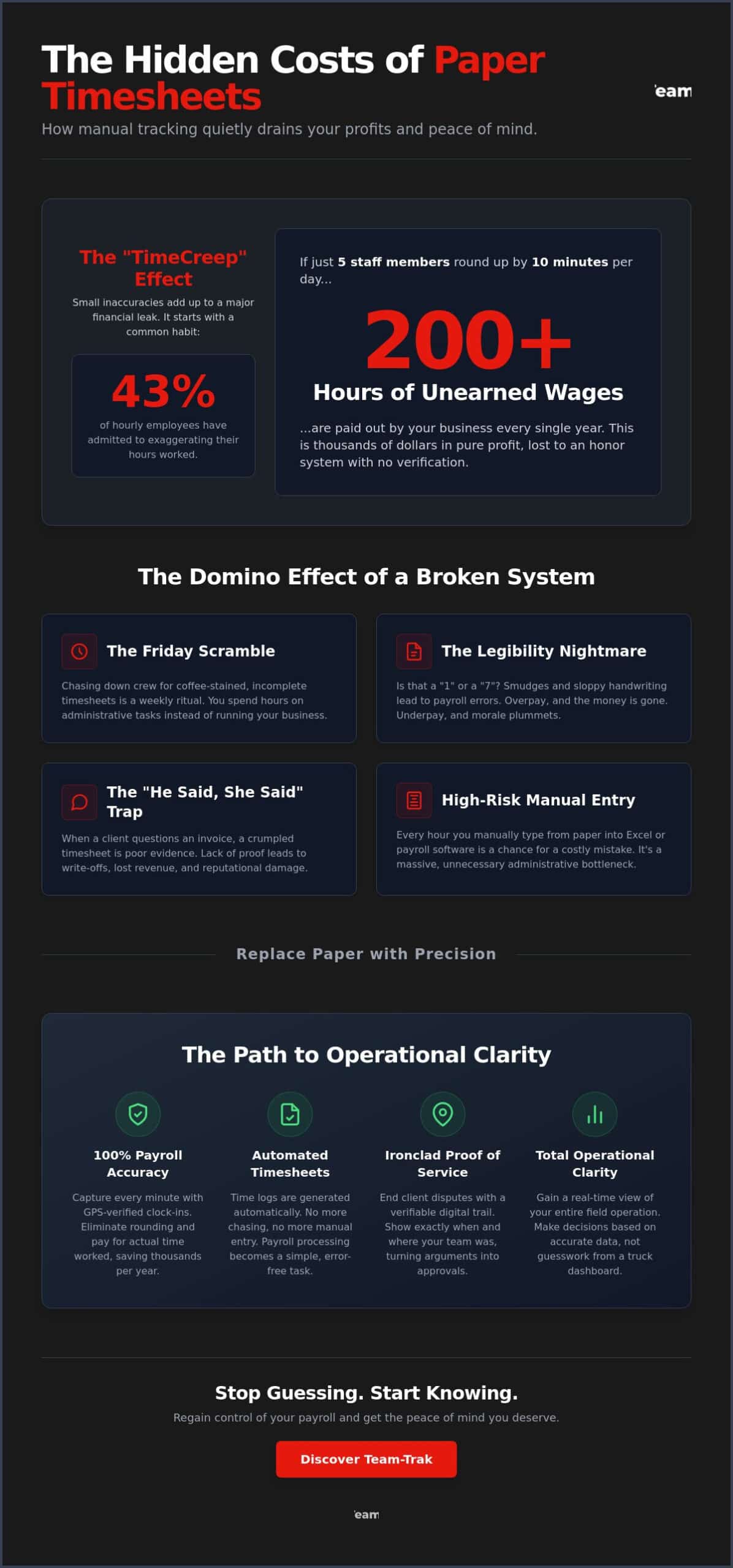
It’s 4:30 PM on a Friday, and instead of heading home, you’re stuck at your desk smoothing out a coffee-stained page you found on a truck dashboard. You’re squinting at illegible handwriting, trying to figure out if a job really took four hours or if that’s just a convenient round number. If you feel like you’re paying for “estimated” time rather than actual work, you’re likely right. Research shows that 43% of hourly employees have admitted to exaggerating their hours at some point. These common problems with paper timesheets do more than just clutter your desk; they actively erode your profit margins and create unnecessary friction with your team.
We understand the frustration because we’ve lived it. Most operators stick with manual logs because they feel familiar, but they eventually create a wall between you and the truth of your field operations. You deserve to know exactly where your team is and that your payroll is 100% accurate every single week without the administrative headache.
In this guide, we’ll break down why manual tracking is a liability for your reputation and how to fix it without the stress of a complicated tech rollout. You will discover how to eliminate the Friday scramble, stop “TimeCreep” from draining your bank account, and finally get the peace of mind that comes with total operational clarity.
Key Takeaways
- Understand why the “Friday scramble” is a symptom of a broken system rather than a lack of staff discipline.
- Identify how the hidden problems with paper timesheets lead to “TimeCreep,” costing you thousands in unearned wages every year.
- Learn how to shift from “he-said, she-said” client disputes to a model of total accountability with verified proof of service.
- Evaluate why common alternatives like WhatsApp groups often fail to provide the structured data needed for accurate invoicing and payroll.
- Discover a practical path to operational clarity that prioritizes your peace of mind over complex technology.
The Friday Afternoon Scramble: Why Paper Timesheets Are Failing Your Field Team
If you have ever spent your Friday evening chasing down crew members for their logs, you know the “Friday Scramble” all too well. It is easy to blame the staff for being disorganized, but the truth is that this chaos is a systemic failure. When your business relies on physical logs, you are asking your team to be both technicians and administrative assistants. In the high-pressure environment of trades and field service companies, paperwork is always the first thing to be neglected. It isn’t a personality flaw; it’s a predictable result of using the wrong tools for the job.
The physical vulnerability of paper is a constant risk. We have seen sheets that are illegible due to coffee stains, torn after being shoved under a van seat, or simply lost between the job site and the office. These common problems with paper timesheets create a culture of “trust but cannot verify.” You want to trust your team, but without a digital trail, you are essentially guessing. Relying on traditional timesheet methods means your payroll is only as accurate as your staff’s memory on a Friday afternoon. The antidote to this disorder is Operational Clarity, a state where every hour worked is backed by proof, not just a crumpled piece of paper.
The Administrative Bottleneck
Calculating hours by hand is a high-risk task. Even the most careful operator makes simple math errors when they are tired. Then there is the hidden cost of “chasing.” Think about how many hours you spend every month texting or calling staff to ask, “Where is your sheet?” or “Did you forget to write down Wednesday?” Once you finally get the paper, you usually have to double-handle that data by typing it into Excel or an accounting system like Xero. This manual entry is a recipe for payroll disaster and a massive drain on your time. Moving toward operational simplicity means removing these bottlenecks entirely.
The Legibility Nightmare
Decoding “doctor-style” handwriting on a Monday morning is a poor use of a founder’s expertise. When a “1” looks like a “7,” your bottom line suffers the difference. If you overpay an employee because of a smudge, that money is gone. If you underpay them, you face friction and a loss of morale. Every time you have to call a staff member to clarify what they wrote, you are interrupting their work and yours. These small points of friction might seem minor, but they add up to a significant loss of momentum across your entire operation.
Financial Leakage: The Unseen Costs of Manual Data Entry
Paper systems have a way of making every workday look suspiciously perfect. When you review a stack of sheets, you will see a lot of 8:00 AM starts and 4:30 PM finishes. In reality, the crew might have arrived at 8:12 and packed up by 4:15. This isn’t necessarily malicious. It is simply the nature of the medium. Paper doesn’t capture the small gaps. It only captures what the hand writes down after the fact. This lack of precision creates a steady drain on your bank account that most founders don’t notice until it is too late.
These financial problems with paper timesheets are often invisible until you see them aggregated over a full quarter. If five staff members round up by just 10 minutes a day, you’re paying for over 200 hours of work that never happened every single year. At a standard hourly rate, that’s thousands of dollars in pure profit leaking out of your business. This “TimeCreep” is the difference between a business that’s just surviving and one that’s truly scaling.
The “Rounding Up” Culture
Staff rarely round down. Paper systems encourage a default entry mindset because it’s easier to write “8:30” than “8:37.” The psychological shift that happens when you move from an honor system to a verified system is significant. It isn’t about a lack of trust. It’s about establishing a standard of precision. When the team knows that timesheet automation is in place, the “rounding” culture disappears. Accuracy becomes the new baseline for everyone.
Payroll Processing Inefficiency
Beyond just overpayment, there’s the risk of underpayment and compliance. Research indicates that correcting a single payroll error costs an average of $291 when you factor in administrative time and potential penalties. If a staff member loses a sheet and you guess their hours incorrectly, you’re opening the door to a Department of Labor dispute. You can’t defend your business against a claim if your only evidence is a coffee-stained logbook. You need a system that offers “proof of work” as a standard feature.
This delay also creates cash flow friction. It makes it nearly impossible to link hours worked to specific client invoices in real time. By linking to online accounting systems like Xero or QuickBooks, you can turn a three-day admin nightmare into a twenty-minute task. If you’re ready to stop the leakage, you can reach out to us to discuss your setup. Total operational clarity isn’t just about saving time. It’s about protecting every dollar your business earns.
The Client Dispute Trap: Why “He Said, She Said” Costs You Money
We have all had that awkward phone call. A client calls on a Tuesday morning, claiming your team left the site thirty minutes early. You pull the physical log from the folder, and it clearly says they finished at 5:00 PM. The client insists they saw the van pull away at 4:30 PM. In this scenario, you are stuck. Without objective data, you either have to call your staff a liar or tell the client they are wrong. Neither option is good for business.
This “he said, she said” dynamic is one of the most expensive problems with paper timesheets. When you can’t provide a definitive answer, you usually end up offering a “goodwill credit” just to keep the peace. These credits are a direct hit to your profit margins. Even worse, they set a precedent that your invoices are negotiable. If you can’t prove the work was done, you lose the authority to stand by your pricing. Accountability isn’t just about catching staff doing the wrong thing. It is about protecting your business reputation when you have done everything right.
Protecting Your Reputation with Proof of Service
In the service industry, “Proof of Work” is far more valuable than a simple “Time on Site” entry. A digital trail provides a layer of protection that paper simply cannot match. When a client questions an invoice, being able to pull up a record of GPS location verification changes the entire conversation. It moves the discussion from an emotional argument to a factual review. Instead of apologizing for a perceived mistake, you can confidently show exactly when your team arrived and departed. This level of transparency is exactly what modern clients expect, especially in sectors like short term rental and airbnb hosting where timing is everything.
Reducing Billing Friction
Invoices backed by hard data are paid faster. It’s a simple fact of business. When a commercial client sees that your billing is based on verified check-ins rather than manual notes, their level of trust in your company increases. You are no longer just another contractor; you are a professional partner with simplified operations and clear standards. There is a massive sense of relief in knowing you can back up every penny on your invoice. You don’t have to dread the “invoice query” email because you already have the proof ready to go.
Beyond the Clipboard: Modern Alternatives for Practical Operators
Once you realize the problems with paper timesheets are holding you back, the natural instinct is to reach for the nearest free tool. Most operators move from clipboards to a WhatsApp group or a shared spreadsheet. It feels like progress because you aren’t chasing physical paper anymore, but you have simply traded one administrative burden for another. These middle ground solutions often create more noise than clarity. You haven’t fixed the system; you’ve just moved the mess into a digital inbox.
The transition from manual logs to true operational clarity requires a shift in how you think about tracking. Instead of asking your staff to be record-keepers, you should look for systems that create records as a byproduct of the work itself. This is the difference between active reporting, which staff hate, and passive tracking, which simplifies everyone’s life.
Why WhatsApp and Spreadsheets Aren’t the Answer
Using a group chat for time tracking is a recipe for information overload. If you need to verify an arrival time from three weeks ago to settle a dispute, you’re stuck scrolling through hundreds of messages about site access, lunch orders, and weather delays. There is no structure and certainly no audit trail. If a labor inspector asks for your records, a series of “I’m here” texts won’t satisfy a compliance check. Spreadsheets are slightly better for storage, but they are essentially just digital paper. They still require your staff to remember their hours and manually type them in. If they were inconsistent with a pen, they’ll be just as inconsistent with a smartphone keyboard. These tools cost you a fortune in owner-time spent on data cleanup.
What to Look for in a Digital System
When you’re ready to move toward a professional setup, prioritize ease of use above all else. In a busy field environment, if a check-in takes more than 10 seconds, your team won’t do it. You need a system that integrates with your existing workflow rather than adding to it. Consider these key features:
- Low-Friction Entry: Look for QR code check-in for static sites like construction projects or cleaning jobs. It’s the ultimate 10-second solution.
- Automated Reporting: The system should do the math for you, linking hours directly to payroll.
- Scheduling Synergy: Your tracking should live alongside smart schedules so staff know exactly where they need to be and when.
The goal is a system that works for your staff, not against them. If you are tired of the middle ground and want a system built by people who have actually lived the scramble, get in touch with us today to see how we can help you achieve total operational clarity.
Operational Clarity: How Team-Trak Replaces Paper with Precision
We didn’t design Team-Trak in a software lab. We built it because we were tired of the same problems with paper timesheets that you are facing right now. We have lived the Friday scramble. We have squinted at the illegible handwriting and handled the awkward client calls. This platform is the result of those frustrations. It is a tool built by operators for real businesses who need results, not just another complicated app to manage. The goal is simple: to replace the mess of manual logs with a single source of truth that provides total operational clarity.
The transition to a digital system doesn’t have to be a headache. In fact, it is a one-time setup that provides a lifetime of administrative relief. By moving your team onto the mobile staff app, you create a bridge between what happens in the field and what shows up in your payroll. You are no longer guessing or “estimating” work. You are making decisions based on precise, verified data. This shift moves the focus from the software to your own relief as a business owner.
GPS-Verified Attendance and QR Check-ins
The core of our platform is the “hands-off” approach to tracking. When your team arrives at a site, they check in using the mobile app or a simple QR code scan. The system automatically captures the time and verifies the location. This creates a digital trail that serves as your ultimate “Proof of Service.” For trades and field service companies, this means you never have to wonder if a crew arrived on time or if a job was actually completed. The system handles the record-keeping so your technicians can focus on the work they were hired to do.
Seamless Integration and Automated Billing
The real magic happens when your verified timesheets flow directly into your invoicing and billing tools. You can end the month-end headache by linking your data to accounting software like Xero or QuickBooks. Instead of spending hours double-handling data from paper to a spreadsheet, you can process an entire week of payroll in minutes. This level of integration ensures that your cash flow remains steady and your records are always audit-ready. At the end of the day, the goal isn’t just to have more technology; it’s to have more time to grow your business and the peace of mind to enjoy it.
Reclaim Your Friday Evenings and Protect Your Profit
Moving away from manual systems isn’t just about adopting a new app. It’s about deciding that your time is too valuable to spend chasing crumpled logs or settling avoidable client disputes. We’ve explored how the hidden problems with paper timesheets lead to “TimeCreep” and payroll errors that cost an average of $291 to correct. By shifting to a verified model, you aren’t just saving money; you’re building a business based on transparency and operational clarity. You finally get to stop guessing and start knowing.
Team-Trak provides the tools you need to succeed in the field, including GPS-verified attendance and direct Xero or QuickBooks integration. It is built for real-world field operations because we know exactly what it’s like to be in your shoes. You deserve a system that works as hard as your crew does and an administrative process that doesn’t feel like a second job. It’s time to put down the clipboard for good.
Stop the Friday scramble and automate your timesheets today with Team-Trak. You have built a great business through hard work and dedication. Now it’s time to give yourself the structural support and peace of mind to actually enjoy the growth you’ve earned.
Frequently Asked Questions
Are paper timesheets legal for payroll in 2026?
Yes, paper logs are still legal under the Fair Labor Standards Act (FLSA), provided they are accurate and kept for a minimum of three years. However, the burden of proof for hours worked falls entirely on the employer. If a dispute arises, a handwritten note is much harder to defend than a digital record. Most modern operators move away from manual logs to ensure they meet these strict compliance standards without the stress.
How do I get my field staff to switch from paper to an app?
Focus on how the change makes their life easier rather than how it monitors them. Explain that a mobile app removes the “Friday scramble” and ensures they are paid accurately for every minute they work. When you frame it as a tool for their protection, adoption increases. We’ve found that showing the team how to check in via a simple QR code scan usually removes any technical anxiety.
What is the most common mistake when moving away from manual timesheets?
The biggest error is choosing a system that is too complex for the field. If a check-in process takes more than a few seconds, staff will revert to their old habits. Another mistake is failing to integrate the new data with existing accounting tools like Xero or QuickBooks. You want a solution that simplifies your workflow, not one that adds a new layer of data entry for the office.
Can digital timesheets really prevent time theft in field services?
Digital systems significantly reduce time theft by replacing the honor system with verified data. Research shows that 43% of hourly employees have admitted to exaggerating their hours, and 75% of U.S. businesses are affected by buddy punching. These systems solve the common problems with paper timesheets by using GPS location verification to ensure staff are actually on-site. This transparency naturally eliminates the rounding errors and TimeCreep that often drain your profitability.
How much time can a service business save by automating timesheets?
Most service businesses save several hours per week by removing manual data entry and chasing tasks. Instead of decoding handwriting and manually typing hours into a spreadsheet, the data flows directly into your payroll system. This automation can turn a three-day administrative nightmare into a task that takes less than an hour. It frees you up to focus on growing the business instead of managing paperwork and correcting errors.
What happens if a staff member forgets to check in on a mobile app?
Human error happens, but digital systems make it much easier to fix. If an employee forgets to check in, an administrator can manually adjust the entry based on other proof of service. Unlike the typical problems with paper timesheets, where a missing entry is a total mystery, digital platforms provide a clear audit trail. You can resolve the issue in seconds without the usual Monday morning stress or missing data.
Do I need a separate GPS device for every vehicle to track time?
No, you don’t need to purchase or install any expensive hardware devices in your vehicles. Modern systems like Team-Trak use the GPS capabilities already built into your staff’s smartphones via the mobile app. This approach is much more cost-effective and flexible than traditional vehicle tracking. It allows you to verify attendance at the specific job site rather than just knowing where the truck is parked during the day.
How does digital time tracking help with commercial client disputes?
It replaces “he-said, she-said” arguments with objective, data-driven proof. If a client claims your team arrived late, you can pull a report showing the exact GPS-verified check-in time. This transparency builds long-term trust and protects your reputation. Invoices backed by verified data are paid faster and are much harder for a skeptical customer to question. It provides the Proof of Service needed to stand by your billing.

Disclaimer
The information provided in this article is for general informational purposes only and reflects the opinions and experiences of the author. While every effort has been made to ensure accuracy, Team Trak makes no guarantees regarding completeness