It is 4:45 PM on a Friday, and instead of heading home, you are digging through messy paper tickets to prove to a skeptical client that your team was actually there for four hours. You know the frustration of a client questioning an invoice because they felt disconnected from the work happening on-site. It is exhausting to provide excellent service only to have its value debated because of a simple visibility gap. You aren’t alone in this; research shows that 67% of customers now prefer using a client portal for customer retention and self-service over speaking to a company representative.
Building a window into your operations is about more than just technology. It is about replacing the stress of manual reporting with a clear view of your team’s hard work. In this guide, you will discover how providing this level of transparency turns a basic service into an indispensable partnership. We will walk through a practical checklist to help you eliminate billing disputes, get your invoices approved faster, and secure long-term contracts based on proven performance rather than just your word. It is time to stop the constant phone calls and start showing the real value you provide every day.
Key Takeaways
- Identify the “Visibility Gap” and why silence between a service booking and an invoice often leads to lost clients.
- See how GPS and QR code data act as a quiet insurance policy, turning disputable hours into verifiable proof of service.
- Discover how a client portal for customer retention can eliminate the “Friday afternoon scramble” by providing clients with instant access to task completion lists.
- Avoid the trap of over-complicating your setup by keeping your digital tools grounded in your real-world daily operations.
- Learn how to present operational transparency as a premium service upgrade that builds long-term loyalty and trust.
The Visibility Gap: Why Service Clients Drift Away
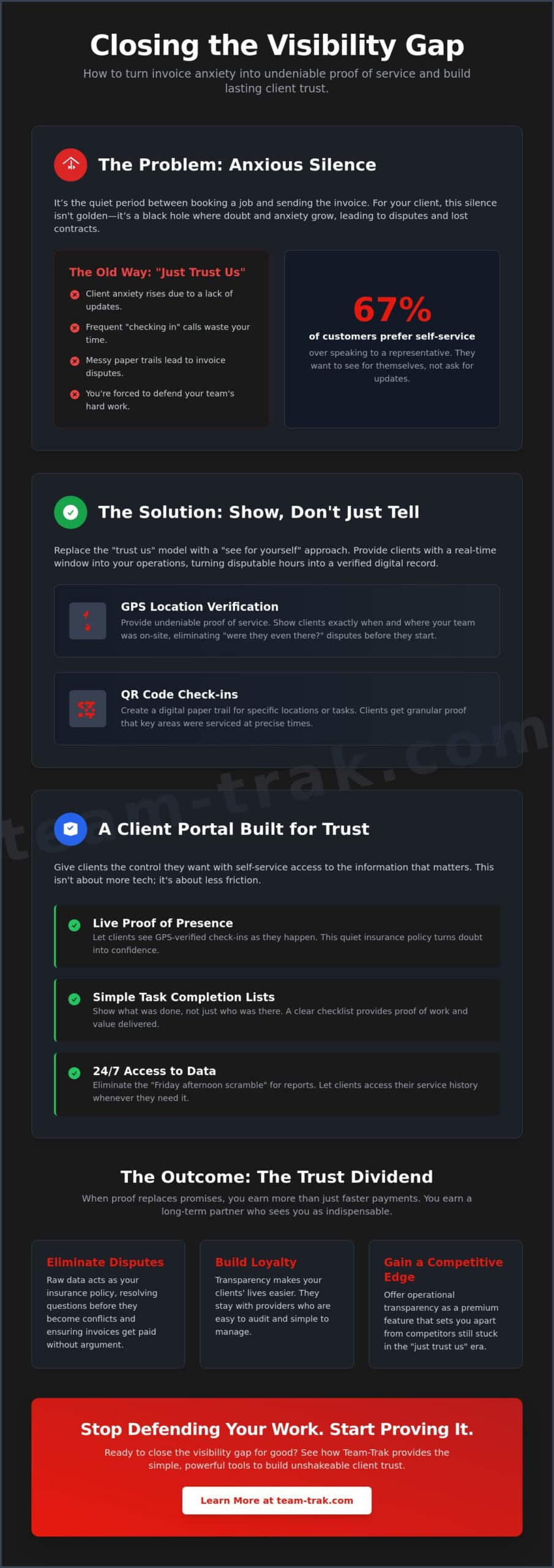
Silence is rarely golden in the service industry. For many business owners, there is a recurring black hole in the customer experience. This is the Visibility Gap. It is the period of silence that begins the moment a client books a job and ends only when they receive an invoice. During this stretch of time, your team is working hard, but to the client, that labor is invisible. They see the bill, but they didn’t see the sweat. This disconnect is where doubt begins to grow.
Many operators fall into the trap of believing that “no news is good news.” They assume that if the client isn’t complaining, they must be happy. This is a myth that leads directly to client churn. In reality, silence often creates anxiety. When a client feels disconnected from the work happening on-site, they start to wonder if they are getting what they paid for. They wonder if the team arrived on time or if the hours billed match the work performed. Trust is a finite resource; it is depleted every time a manual report contains a typo or a time entry looks suspiciously rounded up.
The High Cost of “Checking In”
Every phone call from a worried client asking if the team arrived is a symptom of a visibility failure. These “quick check-ins” are not harmless. They steal time from your actual billable work and force you into a defensive crouch. You end up chasing down staff for updates just to satisfy a nervous customer. Relying on a “just trust us” strategy is no longer viable. Modern customer retention depends on removing this friction entirely. If a client has to ask for an update, you have already lost a small piece of their confidence.
The Psychology of the Client Portal
A portal is much more than a technical add-on; it is an emotional relief valve for your customers. By implementing a client portal for customer retention, you shift your business from a reactive “call me” model to a proactive “see for yourself” model. It gives the client a sense of control and ownership over the service they are buying. When they can log in and see GPS location verification or live check-in data, the mystery of the work disappears. A portal replaces the nagging anxiety of paying for invisible labor with the calm of concrete evidence. It transforms your relationship from a simple transaction into a transparent, unshakeable partnership.
The Trust Dividend: How Proof of Presence Drives Loyalty
Trust in the field service industry isn’t a vague concept; it’s a measurable asset. When you move beyond verbal promises and start providing raw data, you stop being just another vendor. You become a partner. This shift creates what we call the Trust Dividend. It is the loyalty you earn when a client never has to wonder if they are being overcharged. Using a client portal for customer retention allows you to share this proof of work effortlessly, turning every job into a building block for a long-term contract. It moves the conversation from “what did I pay for?” to “look at what was accomplished.”
Eliminating the “Were They There?” Dispute
In high-stakes industries like construction, the question of presence can hold up thousands of dollars in payments. You can eliminate this friction by using GPS location verification to provide undeniable proof of service. When paired with QR code check-ins, you create a digital paper trail that clients can access 24/7. This isn’t just about surveillance; it’s an insurance policy for your relationship. If a dispute arises, the evidence is already waiting in their portal, ready to resolve the issue before it turns into a conflict.
Turning Accountability into a Competitive Edge
Accountability is your best sales tool. Clients stay with the provider who makes their life easiest, and that usually means the provider who is the simplest to audit. By giving them self-service access to attendance data and task checklists, you remove the “Administrative Tax” they usually pay just to manage your team. This approach aligns with modern customer retention management strategies that prioritize transparency and value. For a deeper look at managing your team effectively, see our guide on Mastering Field Workforce Management Software.
Providing this level of clarity ensures your performance is never up for debate. When you provide checklists that prove specific tasks were finished, you aren’t just selling time; you’re selling results. You can simplify operations and build a reputation for reliability that competitors can’t touch. If you’re ready to stop the billing disputes and start building unshakeable trust, see how we can help you regain control.
The Field Service Client Portal Checklist: 5 Essentials
A good portal isn’t about fancy graphics or complex data dashboards. It is about answering the five questions your clients are already asking themselves. When you implement a client portal for customer retention, you are essentially giving your clients a key to your operations. It allows them to find answers on their own schedule, which helps strengthen trust, and increase customer retention without you needing to send a single email. By providing a client portal for customer retention, you are proving that your business has nothing to hide. Here are the five non-negotiables your portal must provide:
- Real-Time Attendance: Clients should be able to see exactly when your team checked in today. No phone calls required.
- Task Transparency: Job-specific checklists should be visible the moment they are completed.
- Historical Records: A searchable archive of every past visit, report, and photo provides proof of long-term performance.
- Financial Clarity: Your portal should show automated timesheets and pending invoices in one clear view.
- Simplified Communication: A direct way to request a schedule change or a task update stops the endless email threads.
Feature 1: The Digital Paper Trail
Monthly summaries are fine, but an activity log is what actually builds confidence. For short-term rental and Airbnb hosts, this is critical. They need to verify that a turnover happened before the next guest arrives at 3:00 PM. Seeing a live check-in notification is the difference between a relaxing afternoon and a stressful one. This level of detail is why many operators are moving toward using an Automated Timesheets sibling article to end the Friday afternoon scramble once and for all.
Feature 2: Self-Service Billing and Reports
The most common source of friction in field services is the delay between work being done and an invoice being sent. When you link your portal data to your online accounting systems, you close that gap instantly. Clients can see what they owe and what has been paid without having to ask you for a statement. The ultimate goal is simple: make it much easier for your clients to pay you than it would be for them to fire you. If you want to see how these features can transform your business and help you regain control, get in touch with us today.
Launching Your Portal Without Adding to Your Admin Burden
Many business owners hesitate to adopt new technology because they fear it will create a second job. They don’t want to spend their evenings managing software instead of their business. The trick is to keep your setup grounded in your actual daily operations. Don’t build a complex digital maze. Instead, use a client portal for customer retention as a quiet background tool that captures the work you are already doing. It should feel like a natural extension of your service, not an extra chore.
When you roll this out, don’t frame it as “new software” to your customers. Tell your clients it is a “Premium Visibility Upgrade.” It is a value-add that makes their life easier by giving them instant answers. This shift moves you away from “old school” manual reporting while keeping that essential human touch. You are still the expert; you just have better tools to prove it. Framing the portal this way ensures it is seen as a benefit rather than a hurdle.
Training Your Team (and Your Clients)
Success depends on making the portal your “Single Source of Truth.” If a check-in isn’t recorded or a task isn’t checked off, it simply didn’t happen. This clarity protects everyone and sets clear expectations. A mobile-first approach is non-negotiable for trades and field service companies because your team is always on the move. Keep the interface simple. If a client or a technician has to click more than twice to find what they need, they won’t use it. Simplicity is what drives adoption and results.
The Quiet Solution for Peace of Mind
Using a client portal for customer retention eventually moves you from the role of “firefighter” to “leader.” You stop reacting to every minor dispute and start focusing on growth. Visibility is the ultimate retention tool because it removes the need for constant reassurance. When your clients have peace of mind, they stop shopping for alternatives. They value the partnership you’ve built on proof rather than just promises. If you’re ready to stop the administrative drain and regain control, see how Team-Trak simplifies your client reporting and gives you your time back.
Take Control of Your Client Relationships Today
Retaining a client shouldn’t feel like a constant battle of your word against theirs. By closing the visibility gap, you replace doubt with data and anxiety with evidence. A client portal for customer retention isn’t just another administrative task; it’s a way to give your clients the peace of mind they are already paying for. You’ve seen how a few simple tools can turn a standard service into an indispensable partnership that is much harder to walk away from.
It’s time to stop chasing down updates and start leading your business with confidence. With GPS-verified attendance records and QR code check-ins, you provide undeniable proof of work that prevents disputes before they start. Plus, seamless integration with Xero and QuickBooks ensures your billing is as transparent as your service. You deserve a business that runs on proof, not pressure. When you provide this level of clarity, you aren’t just a vendor; you are a trusted partner.
Ready to change the way your clients see you? Stop the disputes and start building trust with Team-Trak today. You have worked hard to build your business; now let’s make sure your clients see the full value of that effort.
Frequently Asked Questions
How does a client portal actually help with customer retention?
A client portal for customer retention works by eliminating the “Visibility Gap” through verifiable proof of service. When a customer can see live check-in data and task checklists, they don’t have to call you to confirm the team arrived. This transparency turns a simple transaction into a partnership based on accountability. It makes your service much harder to replace because you are the provider who is the easiest to trust and audit.
Will my clients actually use a portal, or is it just more work for them?
Most customers actually prefer using a portal because it gives them answers without the need for a phone call. Research shows that 67% of customers prefer self-service portals over speaking to a representative. For your clients, it isn’t more work; it is a way to get information instantly on their own schedule. They can check an invoice or a service report at 10:00 PM without waiting for your office to open.
Is a client portal secure for sharing financial and attendance data?
Security is a top priority, especially with recent regulations like the 2026 CCPA amendments requiring annual cybersecurity audits for businesses meeting specific data thresholds. A professional client portal for customer retention uses secure, encrypted logins to ensure that each client only sees their own specific data. This setup protects sensitive financial records and attendance logs better than sending unsecured PDFs via email. It provides a controlled, safe environment for all your service documentation.
Do I need a separate portal for every client, or can they all log into one place?
You don’t need to manage multiple systems; all your clients log into a single, secure platform using their own unique credentials. The software automatically filters the data so a client only sees the reports, invoices, and GPS check-ins related to their specific jobs. This centralized approach keeps your administration simple while giving every customer a personalized experience. It allows you to scale your business without creating a mess of separate links and passwords.
What is the difference between a client portal and a CRM?
While a CRM focuses on managing sales leads and marketing, a client portal is designed for service delivery and proof of work. CRMs help you get the job, but a portal helps you keep the client by providing transparency after the contract is signed. It focuses on operational realism, such as showing live attendance and task completion, rather than just tracking email history or sales pipelines. It is a tool built for long-term accountability.
Can I use a client portal if I only have a small field service team?
A client portal is actually most effective for small teams because it significantly reduces the administrative burden on the owner. You don’t need a back-office staff to handle client queries when the data is available for self-service. Even with a team of two or three, providing professional, digital reports and verifiable check-ins helps you compete with much larger companies. It allows you to stay focused on the work instead of answering the phone.

Disclaimer
The information provided in this article is for general informational purposes only and reflects the opinions and experiences of the author. While every effort has been made to ensure accuracy, Team Trak makes no guarantees regarding completeness