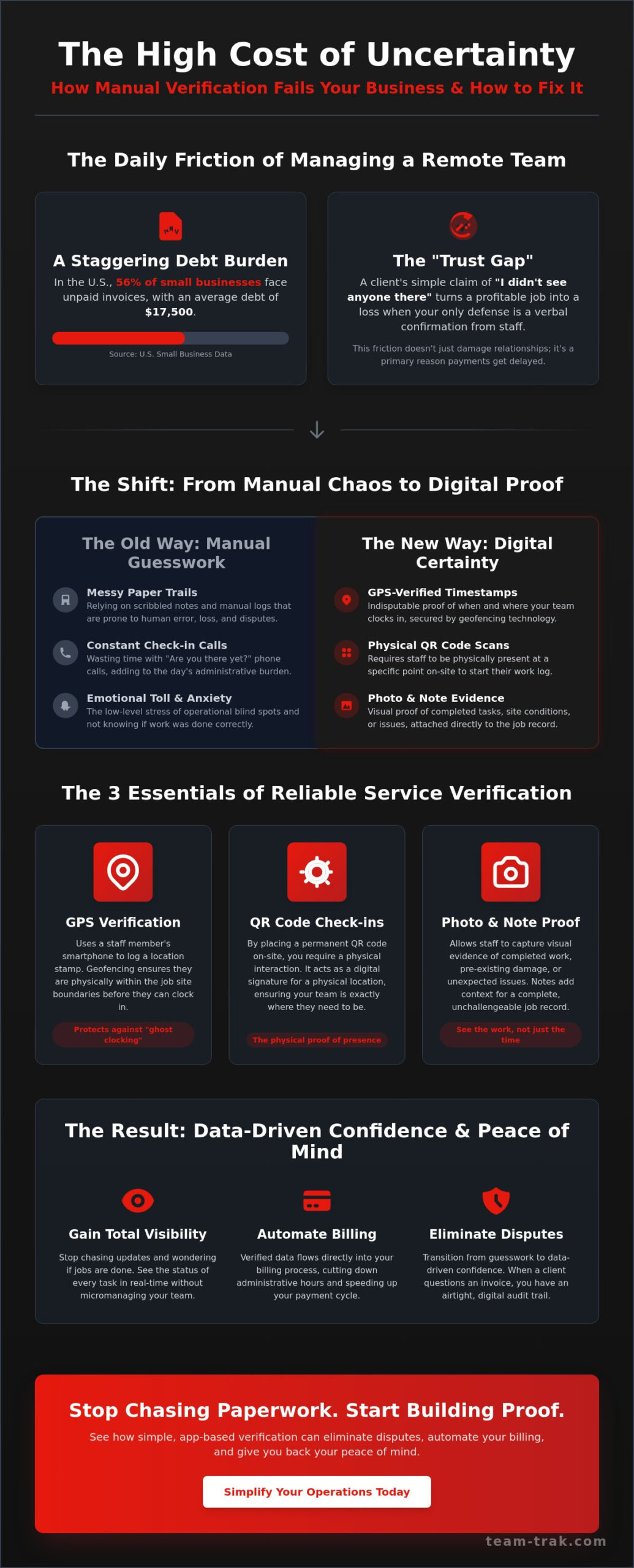
In the U.S., 56% of small businesses are currently sitting on outstanding unpaid invoices, with the average debt reaching $17,500. It’s a draining reality for many owners who find that without a clear digital trail, a client’s simple claim of “I didn’t see anyone there” can turn a profitable job into a total loss. Learning how to provide proof of service to clients shouldn’t involve spending your evenings chasing staff for status updates or arguing over whether a technician actually completed a task. It is exhausting to manage a remote team when you’re constantly second-guessing the manual logs and messy handwritten notes they leave behind.
We know you want to stop the friction and get back to growing your business. You will discover how to eliminate client disputes and automate your billing using simple, app-based verification tools. We will explore how moving from manual reporting to digital proof of work creates a shield of proof for your reputation. This shift ensures you get paid on time while finally giving you the peace of mind that every job is done correctly without the heavy administrative burden.
Key Takeaways
- Stop relying on verbal staff confirmations and close the “Trust Gap” by creating a digital record of every site visit.
- Learn how to provide proof of service to clients using GPS location stamps and QR code check-ins that verify exactly where and when work happened.
- Compare different verification methods to find the right fit for your specific team, whether you manage mobile landscaping crews or fixed-site cleaners.
- See how automated verification data flows directly into your billing process, cutting down on administrative hours and speeding up your payment cycle.
- Shift from chasing updates to having total visibility, ensuring jobs are done correctly without making a single extra phone call.
Beyond the “I Was There” Phone Call: Why Manual Verification Fails
For most service business owners, the phrase “proof of service” sounds like something reserved for a courtroom. In a commercial context, however, service verification is simply the digital proof that a specific task was completed at a specific time and location. It is a modern standard for accountability, similar to the protocols found in Electronic Visit Verification (EVV), which uses technology like GPS and mobile apps to ensure work actually happens. Service verification is a digital audit trail that replaces verbal confirmation with hard, indisputable data.
Relying on a staff member’s verbal “I was there” creates what we call the Trust Gap. When a client questions an invoice, you’re stuck in the middle without a leg to stand on. This friction doesn’t just damage relationships; it’s one of the primary reasons payments get delayed. If you’re wondering how to provide proof of service to clients without a stack of paperwork, the answer lies in moving away from the “he said, she said” model of management.
Manual reporting has a heavy hidden cost. Think about your typical Friday afternoon. You’re likely piecing together text messages, blurry photos, and scribbled notes just to justify your billing. It’s an administrative nightmare that eats your profit and leaves room for human error. When the proof of work is scattered across three different apps and a notebook, you’re bound to miss something.
The Emotional Toll of Operational Blind Spots
Managing a remote team shouldn’t feel like a guessing game. There’s a specific kind of low-level anxiety that comes with not knowing if your crew arrived at a site on time. It’s even worse when a client calls to complain that a job wasn’t done, and you have no data to defend your team’s hard work. Digital verification acts as a tool for quiet management. It removes the need for constant check-in calls because you can see the status of every job in real-time. You gain clarity without being a micromanager.
From Disputes to Data-Driven Confidence
Verified data completely shifts the power dynamic during difficult billing conversations. You stop saying “we think we were there” and start saying “here is the GPS and timestamp proof.” This transition from guesswork to data-driven confidence changes how clients perceive your business. It shows you’re professional, organized, and transparent. Ultimately, simplifying operations starts with removing these daily administrative headaches and replacing them with a clear, automated record of work.
The 3 Essentials of Reliable Service Verification Software
Most software in this space feels like it was built for enterprise giants with massive IT budgets. For a small business owner, you need a solution that works on the devices your team already owns. You don’t need dedicated tracking hardware or complex installations to solve the problem of how to provide proof of service to clients. Instead, you need three core features that work together to create a reliable record of the day’s work.
GPS Verification: Accuracy Without the Hardware
App-based GPS verification uses the staff member’s smartphone to log a location stamp the moment they clock in. It’s a simple, low-cost way to meet the burden of proof for both client billing and internal record-keeping. We use geofencing to make this foolproof. This ensures a staff member is physically within the job site boundaries before they can start their tasks. It protects your business from “ghost clocking” while respecting staff privacy, as the tracking only functions while they are actively on the clock.
QR Codes: The Physical Proof of Presence
Sometimes, a GPS stamp isn’t enough for high-stakes environments like construction sites or short-term rentals. This is where QR code tracking becomes essential. By placing a permanent QR code on-site, you require a physical interaction. The staff member must walk to the specific location and scan the code to verify their arrival. QR codes act as a digital signature for physical locations, ensuring your team is exactly where they need to be.
Knowing they arrived is only half the battle. The other half is knowing they did the job right. Task checklists allow you to verify exactly what work was performed against your own quality standards. When this data syncs in real-time, your office knows the job is finished the second the worker hits “submit.” You stop waiting for paper logs to crawl back to the office at the end of the week. If you’re ready to stop the guesswork and start seeing real-time results, you can see how it works for your team today.
Reliable verification isn’t just about catching mistakes; it’s about building a culture of accountability. When your team knows the system is accurate and fair, they take more pride in their work. You gain the confidence to tell your clients exactly what happened on-site, backed by data that nobody can dispute. This is how to provide proof of service to clients while simultaneously reducing your own administrative stress.
Comparing Verification Methods: GPS vs. QR Codes vs. Photo Proof
Choosing the right verification tool depends on the risk level of the job and the detail your client expects. Not every job requires a photo gallery, but every job needs a baseline of accountability. If you are struggling with how to provide proof of service to clients in a way that is both efficient and indisputable, you must match the method to the operational reality of the work.
GPS tracking is the reliable baseline for mobile teams with multiple stops, such as landscaping or pool maintenance. It proves the van arrived and stayed for the expected duration without requiring the staff to do anything extra. This passive data collection is often enough for residential clients who just want to know you showed up. For a broader look at managing these moving parts, see our guide on Mastering Field Workforce Management Software.
QR codes are the better choice for fixed-site contracts where precision is king. In industries like commercial cleaning or security, a scan proves the staff member didn’t just park nearby; they physically entered the building and reached a specific station. Finally, photo proof and task checklists are essential for high-detail work. According to California’s SPARE Act requirements effective in 2026, even legal process servers must now include a photograph and GPS coordinates to verify service. This highlights a growing trend: clients across all sectors increasingly view a time-stamped photo as the ultimate standard for work completed.
The Value of Layered Verification
The most successful trades and field service companies use a layered approach to build an ironclad reputation. They use GPS to log site arrival and a digital checklist with photo uploads to confirm task completion. This multi-layered data doesn’t just stop disputes; it helps you secure larger, more professional contracts. Clients are willing to pay a premium when they know they’ll receive a detailed report of every job without having to ask for it.
App-Based vs. Hardware-Based Tracking
There is a common myth that you need expensive vehicle trackers to verify service. In reality, hardware-based systems are often overkill and can create a “big brother” atmosphere that hurts staff morale. Using a staff app on a smartphone is more cost-effective and provides better data, such as proof of which specific person performed the task. It increases staff buy-in because the tracking only happens when they’re on the clock, giving them a sense of control while giving you the visibility you need. If you want to see how easy it is to set up these layers for your team, contact us for a practical walkthrough.
Turning Verified Data into Faster Invoices and Peace of Mind
The real value of digital verification isn’t found in the tracking itself. It’s found in what happens after the work day ends. Instead of a pile of paper logs and a flurry of “Where are you?” text messages, you have a clean stream of data ready for your billing tool. This creates a seamless verification-to-invoice pipeline. When your data flows directly into automated timesheets, you stop chasing information and start processing payments. It’s the difference between hoping you get paid and knowing your invoice is indisputable.
Verification data also allows you to offer self-service access through a client portal. Customers can view their own service history, timestamps, and completed checklists without calling your office. This transparency reduces the administrative burden on your staff and provides the “shield of proof” your business needs to stay protected. Digital verification isn’t a chore; it is the foundation of a scalable, professional service business.
Ending the Friday Afternoon Scramble
Most business owners are familiar with the Friday afternoon scramble. It’s those frantic hours spent piecing together hours worked and tasks completed just to get payroll out the door. By using timesheet automation, you eliminate manual data entry errors and the stress that comes with them. You gain the relief of having your payroll and invoicing ready by Friday morning. Business owners who embrace this quiet automation regain hours of their personal time while ensuring their records are precise and reliable.
The Professional Edge: Building Client Trust
In a crowded market, your reputation is your most valuable asset. Providing detailed reports on how to provide proof of service to clients sets you apart from “old school” competitors who still rely on verbal promises. You can use this verified data as a powerful marketing tool. It shows potential customers that you value accountability and precision. This level of professionalism helps you win higher-value contracts with clients who demand transparency and reliable records. Stop the guesswork and start verifying your service with Team-Trak today.
Take Back Control of Your Service Operations
Running a service business is enough of a challenge without the constant friction of disputed invoices and manual data entry. By shifting from “old school” reporting to a digital audit trail, you protect your reputation and your bottom line. You’ve seen how GPS stamps and QR code check-ins create a physical link to the job site that no client can argue with. This data doesn’t just provide visibility; it automates your admin so you can finally get your Friday afternoons back.
Mastering how to provide proof of service to clients is ultimately about building a professional foundation for growth. When your billing is backed by hard evidence, you stop chasing payments and start focusing on your team. We built this platform because we’ve been in your shoes, managing remote crews and feeling that same administrative pressure. It is time to replace the stress of disorganized tasks with the relief of precise, data-driven results.
Start your free trial and simplify your service verification today. Our system includes GPS and QR verification and was designed by operators for operators. There’s no credit card required to start. Take back control of your business and enjoy the peace of mind that comes with total visibility.
Frequently Asked Questions
What is the difference between service verification and employee tracking?
Service verification focuses on the job outcome rather than just the person’s movement. While tracking might show a van’s route, verification confirms a specific person arrived at a specific site and completed their tasks. This distinction is vital for anyone learning how to provide proof of service to clients. It shifts the conversation from surveillance to professional accountability and work quality.
Can service verification software help reduce client invoice disputes?
Yes, it is the most effective way to end billing friction. Disputes often stem from a simple lack of visibility into what happened on-site. By providing clients with timestamps, GPS stamps, and completed checklists, you offer indisputable evidence of work. This data-driven approach turns a difficult conversation into a quick review of the digital record, ensuring you get paid for every hour worked.
Do I need to buy special hardware for service verification?
You don’t need to buy any dedicated hardware or expensive vehicle trackers. The platform is designed to run entirely on the smartphones your team already uses every day. This removes the barrier of high upfront costs and the ongoing maintenance of extra devices. It’s a practical, app-based solution that fits into your existing workflow without requiring a major technology investment.
How does QR code check-in work for mobile staff?
Staff simply scan a permanent QR code placed at the job site using their mobile app. This scan creates a physical link between the worker and the location that GPS alone can’t always match. It is a perfect solution for commercial cleaning or security contracts where you must prove your team was exactly where they were supposed to be at a specific time.
Is service verification software affordable for small businesses?
Digital verification is built to be a cost-effective tool for small and growing teams. Most business owners find the investment pays for itself by eliminating the “Friday scramble” and reducing the average cost of unpaid invoices that many small businesses face. You gain the professional edge of a large corporation without the complex enterprise infrastructure or the heavy administrative price tag.
What happens if my staff forget to check in or out?
If a staff member misses a scan, managers can easily review and manually adjust the record. However, the system uses geofencing and automatic reminders to help your team stay on track. These features reduce the need for manual corrections over time. The goal is to simplify your operations so that verification becomes a natural, effortless part of your team’s daily routine.

Disclaimer
The information provided in this article is for general informational purposes only and reflects the opinions and experiences of the author. While every effort has been made to ensure accuracy, Team Trak makes no guarantees regarding completeness