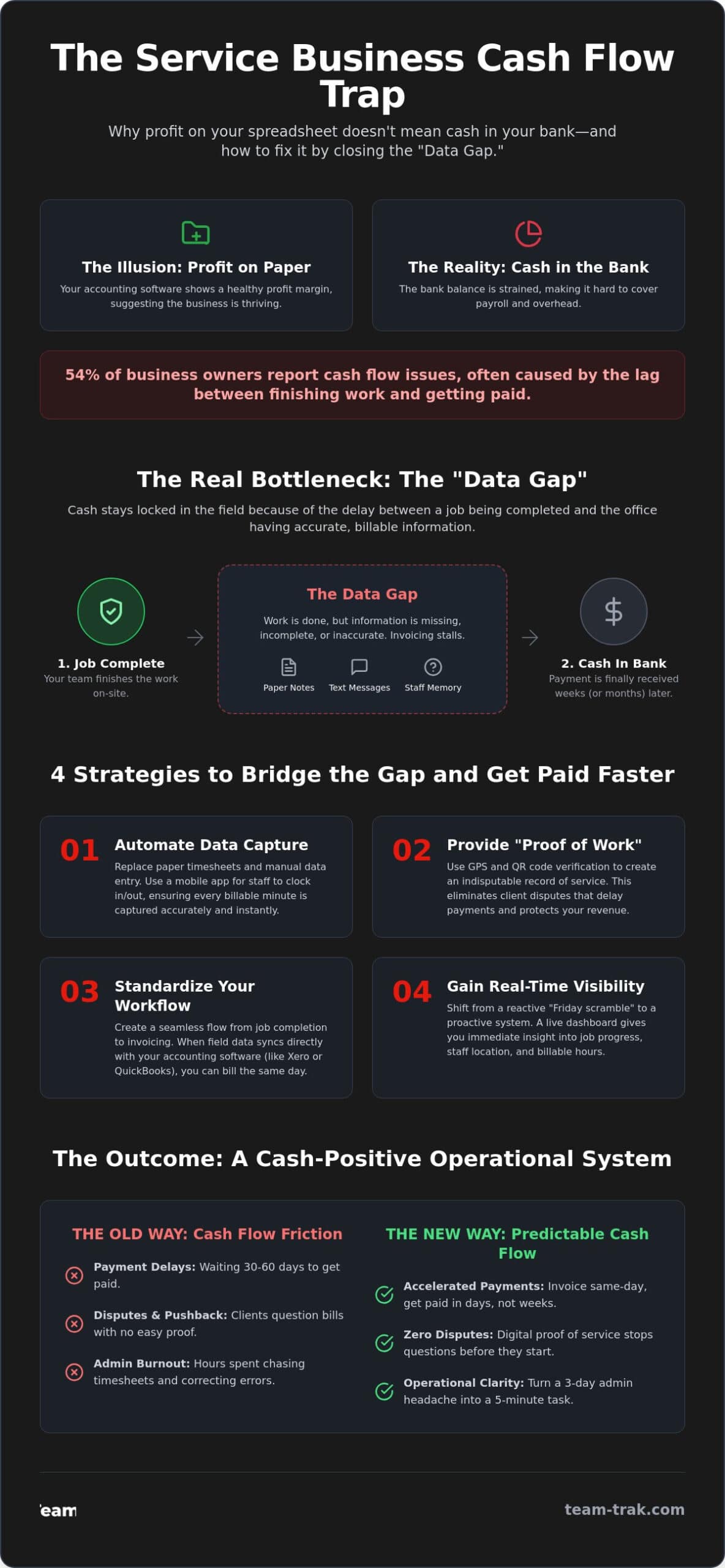
It’s 4:30 PM on a Friday, and instead of heading home, you’re stuck chasing staff for missing timesheets or fielding a call from a client who’s disputing a bill from two weeks ago. You know the work was done, but your bank balance doesn’t reflect the sweat your team put in this week. 54% of business owners report cash flow issues in 2026, and for most operators, improving cash flow for service businesses isn’t about finding more work. It’s about reducing the friction between finishing a job and actually seeing the cash in your account.
We agree that waiting weeks for payment while your overhead keeps ticking is unsustainable. This guide shows you how to bridge that gap by fixing the operational leaks that delay your payments. We are going to explore how to eliminate the administrative scramble, provide indisputable proof of service to stop disputes, and speed up your invoicing cycle. By the end, you’ll have a clear framework for turning completed jobs into a predictable bank balance without the manual data entry burnout.
Key Takeaways
- Identify the hidden “data gap” between job completion and invoicing that keeps your earned cash locked in the field.
- Learn why improving cash flow for service businesses starts with operational verification rather than just accounting adjustments.
- Discover how GPS and QR-based “Proof of Work” prevents the client disputes that act as silent killers of your bank balance.
- Standardize your workflow to automate the transition from staff timesheets to client-ready invoices, cutting days off your billing cycle.
- Shift from reactive “Friday afternoon scrambles” to a proactive system that provides real-time visibility into your workforce and revenue.
The Service Business Cash Flow Trap: Why Profit is Not Cash
You look at your accounting software and see a healthy profit margin. Then you look at your bank account and wonder where the money went. This is the classic trap for operators in labor-intensive industries like cleaning, construction, or home care. Profit is a theoretical figure on a spreadsheet; cash flow is the actual movement of money into and out of your business. If your cash is tied up in unbilled hours or disputed invoices, your “profitable” business is actually at risk of stalling.
Service businesses are uniquely vulnerable because they sell time. Unlike a retail store that collects payment at the point of sale, you often provide the service first and wait weeks to get paid. Understanding this distinction is the first step toward improving cash flow for service businesses. When your billing cycle is “leaky,” you are essentially providing interest-free loans to your clients while your own bills pile up. Signs of a leaky cycle include high accounts receivable, frequent payroll stress, and a constant need to dip into credit lines to cover basic operations.
The “Friday Afternoon Scramble” and its Hidden Costs
For many owners, the week ends with a frantic search for missing data. You spend hours chasing staff for manual timesheets or deciphering messy handwriting on paper job cards. This administrative lag is expensive. Every day you spend collecting data is another day you aren’t sending an invoice. Worse, “roughly correct” data leads to client pushback. If a client questions a bill and you can’t provide immediate proof of work, they will delay payment until you do. Transitioning to timesheet automation removes this friction, turning a three-day administrative headache into a five-minute task.
Labour: The Expense That Won’t Wait
Labor is your biggest cost, often making up about 70% of total expenditures for a service business. Your employees expect to be paid on time, every time. This creates a dangerous gap. You pay for the labor today, but you might not see the client’s funds for 30 or 60 days. This is your cash conversion cycle. Taking on more projects without a tight billing framework can actually make your cash position worse, as your payroll obligations grow faster than your collections. To protect your stability, you must simplify operations to ensure that as soon as a staff member finishes a job, the data is ready for billing. Speeding up this internal handoff is the most effective way to keep your bank balance predictable.
Closing the “Data Gap”: Connecting Field Work to the Bank Account
Most operators focus on the bank balance, but the real bottleneck is often what we call the “Data Gap.” This is the stagnant period between a technician finishing a job and the office having enough information to actually send the bill. If your field staff are great at the work but slow with the paperwork, your cash stays locked in their pockets. Improving cash flow for service businesses requires you to treat field data as a financial asset. Without it, your invoicing cycle is always stuck in second gear.
Your accounting software is only as good as the data you feed it. Tools like Xero or QuickBooks are excellent for managing ledgers, but they can’t tell you if a cleaner stayed an extra hour or if a plumber used three more fittings than quoted. When you rely on memory or messy notes, you’re guessing. High-quality field data ensures that every billable minute and every material used is captured immediately. This precision is what moves a business from surviving to thriving.
The Failure of Manual Systems
I’ve seen it a hundred times. A technician finishes a long shift and sends a quick WhatsApp message: “Job done.” That doesn’t help the person in the office who needs to know exactly what was done to justify the invoice. WhatsApp threads, paper notes, and verbal updates are cash flow killers. They lead to “lost revenue” from unrecorded extra tasks that never make it onto the bill because they were simply forgotten in the rush to the next site. When documentation is an afterthought, your profit margins suffer.
The Data Gap is the primary barrier to service business liquidity, representing the stagnant period where work is finished but cannot be billed due to incomplete documentation.
Operational Visibility as a Financial Tool
Moving from reactive to proactive billing means getting updates in real-time. When a staff member checks out via a mobile app, the office should immediately see the verified hours and completed checklists. Using automated timesheets accelerates the loop from payroll to billing by eliminating the need for manual data entry. You no longer have to wait for Friday to start the “scramble” for info. You can invoice the moment the job is done.
Linking field operations directly to your accounting ledger is the ultimate way to secure your finances. As this SBA guide to managing business finances points out, accurate and timely record-keeping is the foundation of a healthy business. By capturing “proof of service” at the source, you create an airtight trail that justifies every dollar you charge. If you’re tired of the lag between work and pay, it might be time to see how better visibility can fix your cycle. Precise data doesn’t just simplify administration; it protects your bank account.
4 Practical Strategies to Improve Cash Flow Quickly
Improving cash flow for service businesses isn’t a slow, theoretical process. It requires immediate changes to how you capture data and interact with your clients. If your business is among the 39% of small firms that don’t have enough cash on hand to cover a single month of operating expenses, you can’t afford to wait. You need to turn completed labor into liquid cash today. These four strategies focus on removing the friction that keeps your money locked in the field.
- Step 1: Standardise your “Proof of Service.” Use GPS verification and QR code check-ins to create a digital paper trail. When a client can’t argue with the time or location of the work, they have no excuse to hold up payment.
- Step 2: Automate the transition from timesheet to invoice. Stop re-typing data. When field staff log hours via a mobile app, that data should flow directly into your billing system.
- Step 3: Implement a Client Portal. Give your customers self-service access to job reports and completion photos. Transparency builds trust and speeds up the approval process.
- Step 4: Link field operations to Xero or QuickBooks. Ensure your operational data and your accounting ledger speak the same language. This eliminates the “Friday scramble” we discussed earlier.
Moving to “Instant” Invoicing
The best time to send an invoice is while the value of your work is still fresh in the client’s mind. Using invoicing software for service businesses allows you to cut your billing cycle in half. I’ve found that sending an invoice within minutes of job completion significantly increases the likelihood of immediate payment. Don’t be afraid to set shorter terms like “Due on Receipt” for one-off jobs. Most clients aren’t trying to be difficult; they just forget. A prompt, professional bill sent while they are still admiring the results is much harder to ignore than one that arrives two weeks later.
Negotiating the “Middle Ground” with Clients
For larger service contracts, waiting until the very end to bill is a massive risk to your improving cash flow for service businesses strategy. Use deposits to cover your initial labor costs and implement progress payments for longer projects. A client portal is essential here. It drastically reduces the “Where is my report?” phone calls that eat your time and stall your payments. When clients can see real-time updates and verified checklists, they feel more comfortable releasing funds. You provide the visibility; they provide the cash. It’s a fair trade that keeps your bank balance healthy and your stress levels low.
The “Proof of Work” Framework: Reducing Disputes and Payment Delays
Nothing stalls a payment faster than a client who thinks they were overcharged or that a job wasn’t finished to spec. Disputes are the silent killers of your bank balance. When a client questions an invoice, that money stays in their account while you spend hours digging through emails, WhatsApp threads, or paper logs to prove your team was actually there. Improving cash flow for service businesses relies on your ability to shut down these arguments before they even start. You need to move from a “trust me” model to a data-driven “proof of work” framework.
In my experience, most disputes aren’t malicious; they’re the result of a lack of visibility. If a client receives a bill for four hours of cleaning but only saw your staff for two, they’re going to push back. Without concrete evidence, you’re stuck in a “he-said, she-said” battle that usually ends with you offering a discount just to get paid. Shifting this dynamic requires operational clarity that provides indisputable evidence of service.
GPS and QR Verification: The New Standard
Legacy systems rely on staff remembering to write down their times. Modern operators use GPS verification to protect themselves from “the staff never showed up” claims. When you can show a client the exact coordinates and timestamp of a check-in, the conversation changes instantly. Using QR code tracking at specific site locations adds another layer of certainty, verifying exact start and end times with surgical precision. Some industry professionals report that moving from manual logs to verified attendance can reduce billing disputes by as much as 40%. This isn’t just about policing staff; it’s about providing the office with the ammunition needed to get invoices approved without delay.
Building Operational Clarity
Beyond just being on-site, you need to prove what was done. Digital checklists turn standard tasks into professional, billable reports that justify your fees. If a technician finds extra work that needs doing, capturing a photo and updating the checklist on-site ensures it actually makes it onto the invoice. This reduces the back-and-forth emails that keep your invoices in the “pending” pile for weeks. When your reporting is detailed and verified, you stop being a vendor they can haggle with and start being a partner they can trust. If you’re ready to stop the “silent killer” of disputes, start building your proof of work framework today. Clear evidence is the fastest path to a cleared check.
Implementing a Cash-Positive Operational System
Many operators view new technology as a daunting cost. In reality, the right field service tracking software is a high-yield investment in your liquidity. When you rely on “old school” manual methods, you aren’t just losing time; you’re losing the precise data required to get paid. Improving cash flow for service businesses requires a shift toward operational realism. It’s about acknowledging that if you can’t verify the work instantly, you can’t bill for it effectively. Moving to a digital system replaces the stress of disorganized administration with the relief of data-driven results.
I’ve seen operators lose thousands because a technician forgot to mention they spent an extra two hours on a site due to a client request. Without a system to capture that in the moment, that revenue simply vanishes. By the time Friday rolls around, the memory of that extra work is gone. A cash-positive system ensures that every billable event is recorded as it happens, bridging the gap between field staff and financial stability. It turns your operations into a predictable engine for growth rather than a source of constant friction.
The Team-Trak Approach to Cash Flow
Our founders didn’t build Team-Trak in a lab; they built it to solve the real-world operational headaches they faced while managing remote teams. The core platform automates the flow of data from the mobile app directly to your office. By linking field data to online accounting systems like Xero or QuickBooks, you eliminate the “middleman” of manual data entry. This transparency doesn’t just help you; it helps your clients feel confident in your professionalism. When they see a verified report with a check-in time and a completed checklist, they have the “proof of service” they need to hit the pay button. It works because it’s built by people who have actually lived the struggle of the Friday afternoon scramble.
Your Next Steps for a Healthier Bank Balance
Fixing your cash flow doesn’t have to happen all at once. Start by auditing your current “time to invoice” metric. How many days pass between a job finishing and an invoice going out? If it’s more than 24 hours, you have a leak. You might trial a digital verification system on a single high-dispute contract to see the difference it makes in payment speed. To see how we can help you simplify operations and protect your margins, book a demo with Team-Trak today. You deserve a business that provides peace of mind and a predictable bank balance, not a weekend spent chasing timesheets.
Secure Your Bank Balance with Operational Clarity
Improving cash flow for service businesses isn’t about working harder; it’s about capturing the value your team already creates. You’ve seen how bridging the data gap and using a proof of work framework removes the friction that keeps your money locked in the field. Verified hours and digital checklists don’t just track attendance. They provide the indisputable evidence needed to get invoices approved without the typical disputes that stall your payments.
The move from manual logs to automated systems is how you get your Friday afternoons back. Team-Trak was built by operators for operators who know that a profitable business is only healthy if the cash is actually in the bank. With GPS and QR-verified proof of service and direct integration with Xero and QuickBooks, you can finally align field work with financial stability. Precise data leads to faster payments and a much needed sense of control.
Ready to stop the scramble? Start your journey to operational clarity with Team-Trak and make your bank balance as reliable as your service. You’ve put in the work. It’s time to see the results in your account.
Frequently Asked Questions
How can a service business improve cash flow without raising prices?
You can boost your bank balance by narrowing the gap between finishing a job and sending the invoice. Improving cash flow for service businesses is often a matter of capturing billable data in real-time rather than waiting for a weekly admin session. By reducing this “billing lag” and eliminating unrecorded extra tasks, you ensure you’re actually getting paid for every minute your team spends on-site.
What is the most common reason for delayed payments in service industries?
The primary culprit is administrative friction caused by incomplete field data. When an invoice lacks verified hours or completed task lists, clients often use the lack of detail as an excuse to delay payment. Providing “Proof of Service” up front removes these hurdles. It settles questions before they turn into disputes, which is the fastest way to get your invoices approved and paid.
How do automated timesheets help with business cash flow?
Automated timesheets eliminate the human error and delays inherent in paper-based systems. Instead of chasing staff for hours on a Friday afternoon, your office receives accurate data the moment a technician checks out via a mobile app. This allows for same-day invoicing. When you bill while the service is still fresh in the client’s mind, you significantly increase the likelihood of prompt payment.
Can GPS tracking really help me get paid faster by clients?
Yes, because GPS verification provides indisputable evidence that your team was where they said they were. If a client questions a bill, a GPS-stamped check-in record ends the debate immediately. It protects your margins from “he-said, she-said” arguments. By providing this level of transparency, you build trust and remove the most common reasons for payment holds on service contracts.
Is it better to use a dedicated invoicing app or a full workforce management platform?
For most operators, a full workforce management platform is the better investment. An invoicing app only helps you once you have the data, but a platform like Team-Trak captures that data at the source. By integrating scheduling, GPS verification, and timesheets into one system, you ensure the information flowing into your invoices is accurate, verified, and ready to be billed immediately.
How do I handle clients who consistently pay late despite verified work?
Start by requiring deposits for larger projects and moving persistent late payers to shorter terms, such as “Due on Receipt.” Use a client portal to give them real-time visibility into job progress and completion photos. Transparency often removes the “I didn’t know it was finished” excuse. If they can see the verified work as it happens, they have very little ground to stand on when withholding funds.
What is the “Data Gap” in service business operations?
The “Data Gap” is the stagnant period between a staff member finishing a job and the office receiving the documentation needed to bill for it. Closing this gap is the most effective strategy for improving cash flow for service businesses. When you move away from WhatsApp or paper notes toward a digital system, you turn that week-long wait into a five-minute automated process.
Do I need to change my accounting software to improve my cash flow?
No, you don’t need to replace your current accounting software. Most high-quality workforce tools are designed to link directly with online systems like Xero and QuickBooks. The goal isn’t to change how you record your money, but to speed up the flow of field data into your ledger. Once your field operations and accounting speak the same language, your billing cycle becomes much faster.

Disclaimer
The information provided in this article is for general informational purposes only and reflects the opinions and experiences of the author. While every effort has been made to ensure accuracy, Team Trak makes no guarantees regarding completeness