
It’s 4:30 PM on a Friday, and you’re staring at a pile of crumpled manual timesheets while a client on line two insists your team never showed up on Tuesday. You know they were there. But you can’t prove it without making five phone calls that nobody wants to answer. This is the daily friction that turns a successful business into a constant administrative headache.
You didn’t start this company to spend your weekends playing detective or arguing over minutes. Many owners hesitate to adopt field service tracking software because they worry about creating a “Big Brother” culture or looking like a micromanager. We get it. But the reality is that visibility isn’t about surveillance; it’s about providing the quiet proof you need to protect your reputation and your team.
Discover how to stop the administrative scramble and regain control of your field operations without the stigma. We’ll show you how automated visibility provides reliable proof of service and frees up your office time, so you can finally trade the Friday afternoon stress for genuine peace of mind.
Key Takeaways
- Learn why true operational visibility is actually about building accountability and protecting your team, rather than just watching location pings.
- Discover how field service tracking software can replace messy manual processes using a simple mobile app instead of complex enterprise hardware.
- Find out how to stop operational leaks by auditing your biggest dispute areas and implementing standardized digital checklists for every site visit.
- Reclaim your Friday afternoons by automating the administrative scramble and using a client portal to reduce constant status update requests.
Field Service Tracking Software: Beyond the Big Brother Myth
The phrase “tracking” often triggers an immediate defensive reaction. For many business owners, it feels like crossing a line into micromanagement. For staff, it can feel like a lack of trust. But when we talk about field service tracking software, we aren’t talking about watching a dot move on a map every second of the day. We’re talking about a quiet, administrative safeguard that protects your business reputation and your team’s integrity.
Accountability vs. Surveillance: Setting the Record Straight
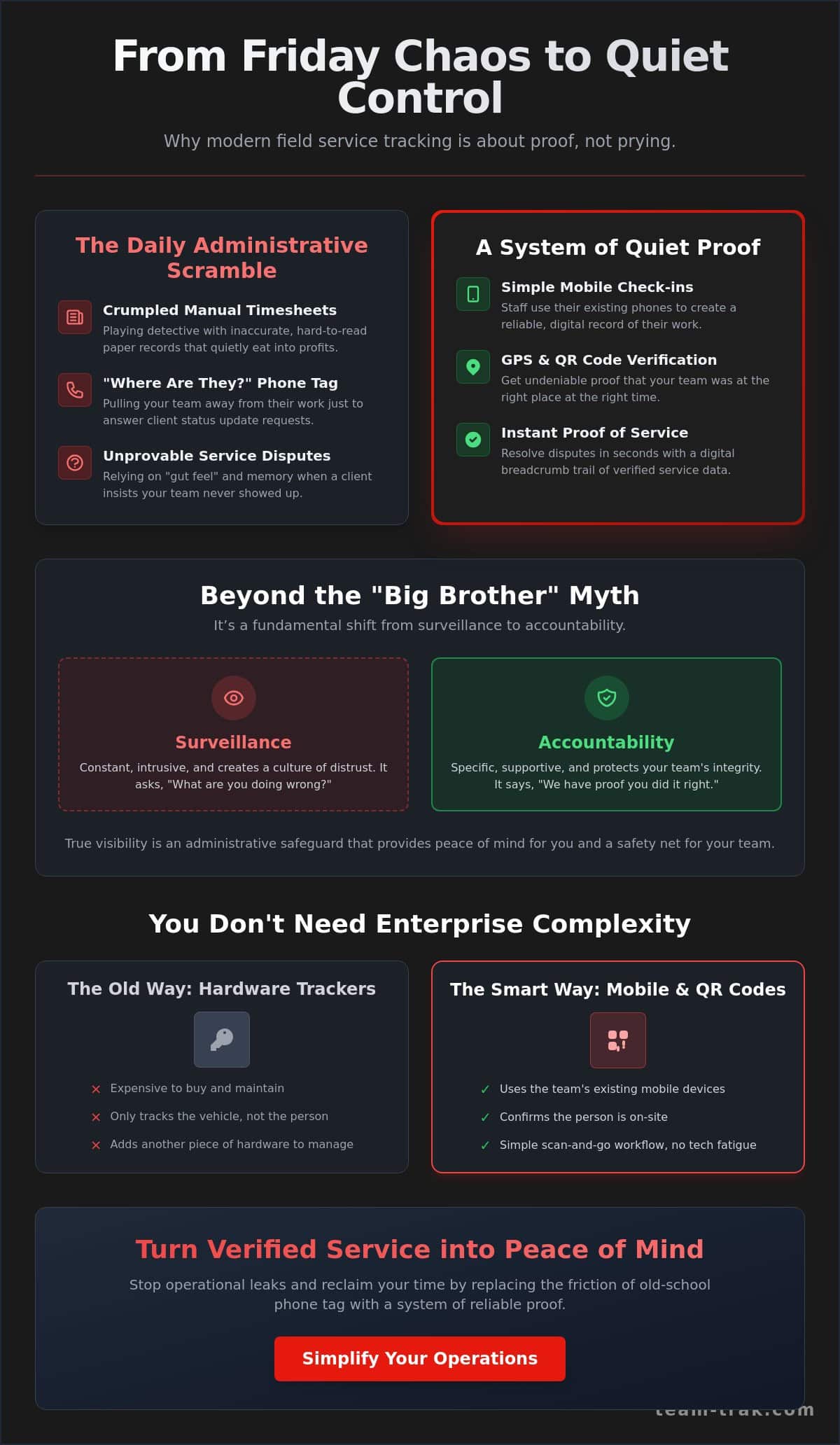
There is a fundamental difference between spying on your team and verifying their work. Surveillance is constant and intrusive; accountability is specific and supportive. Modern systems focus on point-in-time verification, such as a check-in or a completed task list. This provides a digital breadcrumb trail that proves a service was performed exactly when and where you said it would be. Field service tracking is an administrative safeguard that provides the transparency needed to protect service reputations from unfounded client complaints.
Beyond the office, GPS location verification acts as a safety net for remote staff. If a technician is working alone at a remote site, having a record of their location provides peace of mind for their physical safety. It sits within the broader scope of Workforce Management, ensuring that operations run smoothly without the need for constant, manual oversight.
The Hidden Cost of “Trusting Your Gut” Over Data
Operating without data means relying on “gut feel” and estimated arrival times. These estimates are often wrong, leading to financial leaks that quietly drain your margins over time. When a client calls to ask “Where are they?”, the stress of not having an answer is palpable. You end up playing phone tag, pulling your team away from their work just to provide a status update that could have been automated. You can simplify your operations by replacing these frantic calls with data-driven visibility.
- Stop the 4 PM phone scramble to find out who is where.
- Provide immediate proof of service to skeptical clients without hesitation.
- Eliminate the “rounding up” of hours on manual timesheets that eats into profits.
When you have the facts, you don’t need to guess. You stay in the emotional center of your business, focusing on growth rather than dispute resolution. It’s about replacing the friction of old school phone tag with a reliable way to see who is where without making five phone calls. This transition from guessing to knowing is the first step in regaining control of your field operations. The right field technician software makes this transition seamless by providing indisputable proof of service without adding to your administrative burden.
Myth: You Need Enterprise-Level Complexity to Regain Control
Many business owners look at field service tracking software and see a mountain of technical work. They assume they’ll need a dedicated IT department just to keep the system running or a consultant to set it up. This is a leftover belief from the era of heavy enterprise systems. According to Gartner’s definition of FSM, these tools are meant to integrate and optimize resources, but for a small team, “optimization” shouldn’t mean “over-complication.” You don’t need a degree in data science to know if your team arrived on site.
The “all-in-one” promise of large platforms often results in a system that’s too much to handle. You end up paying for hundreds of features you’ll never touch while your office staff spends hours trying to navigate a bloated interface. Real control comes from simplicity. It’s about having a quiet solution that removes problems, not one that adds more digital chores to your Friday afternoon.
Why Hardware Trackers are a Relic of the Past
Traditional methods relied on physical GPS units wired into vehicle dashboards. These are expensive to buy and even more expensive to maintain when they inevitably break or the vehicle is sold. Plus, a vehicle tracker only tells you where the truck is, not what the person is doing. Modern GPS verification happens directly on the staff’s existing mobile devices. It’s lighter, faster, and provides much more context. It’s a practical way to know your team arrived without making five phone calls or managing a fleet of hardware devices.
The Power of the QR Code for Remote Teams
If you want to eliminate check-in friction, look at the QR code. It’s the simplest way to ensure staff are actually on-site rather than just parked nearby. Using QR code tracking means your team doesn’t have to navigate a complex interface. They just scan a code at the job site and get to work. It solves the problem of tech fatigue for crews who are already busy with their hands. For a deeper look at making this work, The Practical Guide to QR Code Check-In and Check-Out offers a clear roadmap for field teams.
When you strip away the enterprise jargon, the goal is simple: visibility and accountability. You want to see who is where without the stress of manual reconciliation. If you’re ready to see how a simpler approach can transform your operations, reach out to us today to discuss your specific business challenges.
Practical Steps to Stop Operational Leaks Without the Admin
Stopping the leaks in your business starts with a simple audit. Look back at your last month of operations. Where did the biggest disputes happen? Usually, it’s the client who claims a service wasn’t performed or the technician who forgot a specific task on-site. These aren’t just minor annoyances. They are financial leaks that drain your time and your margins. By implementing field service tracking software, you move from a culture of verbal promises to one of digital “proof of work.”
The goal isn’t to create more paperwork. It’s to capture the right data at the right time. When you move away from “trusting your gut” and start relying on verified site visits, the administrative pressure begins to lift. You no longer have to be the middleman in every conversation between your staff and your clients. The data speaks for itself.
Similar principles apply to manufacturing; for instance, TrackMyBusiness provides specialized production management software for garment industry to help owners track progress and maintain quality without constant manual check-ins.
Standardising the Day-to-Day with Checklists
Task management is the quiet engine of a reliable service business. It ensures that every team member follows the same high standard, regardless of their experience level. For trades and field service companies, digital checklists are a game changer. They ensure that critical steps, like turning off a water valve or taking a completion photo, are never missed. This simple step eliminates the need for those “did you remember to…” phone calls that interrupt your day and frustrate your team. It’s about building a system that works even when you aren’t watching.
Linking Field Data to the Back Office
The real relief comes when your field data flows directly into your administrative systems. While some discussions around workplace surveillance trends focus on the negative aspects of monitoring, the practical reality for small businesses is far more positive. Verified attendance data feeds directly into timesheet automation, which means you stop chasing crumpled paper at the end of the week. This prepares your business for faster invoicing and more accurate billing without the manual data entry. For a deeper dive into these processes, read Service Tracking Software: A Practical Guide to Operational Visibility.
When your back office is synced with your field team, you regain hours of your life every week. If you are ready to stop the manual scramble and protect your business reputation, get in touch with us to see how we can simplify your operations.
Turning Verified Service into Seamless Peace of Mind
Imagine it’s 3:00 PM on a Friday. Usually, you’d be bracing for the weekly scramble to reconcile hours and answer client queries. Instead, you’re closing your laptop. This is the real promise of field service tracking software. It’s not about watching your team; it’s about regaining your time and mental space. When the system handles the verification, you don’t have to. You move from being a detective to being a founder again.
The psychological relief of a “quiet” business shouldn’t be underestimated. When you know the data is being captured accurately in the background, the constant low-level anxiety of operational uncertainty disappears. You stop wondering if the job was done and start knowing it was. This clarity allows you to lead with confidence rather than reacting to every small friction point that arises throughout the day.
Reducing Client Disputes with Transparency
Client disputes often stem from a simple lack of information. When a customer can’t see the work happening, they naturally start to question the invoice. By providing client portal access, you give them a window into the job without having to send a single manual update. This level of transparency builds long-term trust and ensures customers stick with you for the long haul. It turns a transactional relationship into a partnership built on proof.
In certain sectors, this proof is the foundation of the business. Short-term rental and Airbnb hosts rely on this verification to keep their operations moving. They need to know a property was cleaned and prepared before the next guest arrives. Having that data at their fingertips removes the need for frantic text messages and ensures their own reputation remains intact.
The End of the Manual Timesheet Era
We’ve all lived through the chaos of manual timesheets. The missing papers, the illegible handwriting, and the entries that always seem to be rounded up in the employee’s favor. Moving to an automated system changes the narrative completely. By linking your field operations directly to your accounting systems, you create a single source of truth that everyone can trust. It removes the emotion from payroll and billing discussions.
Team-Trak exists to be the partner that handles the heavy administrative lifting so you don’t have to. We aren’t here to change how you work; we’re here to make the work you do more visible and less stressful. You stay in the lead, while the platform ensures every site visit is documented and every hour is accounted for. It’s time to stop the administrative scramble and get back to leading your business with total clarity. Get started with Team-Trak to simplify your field operations today.
Reclaim Your Time and Operational Clarity
Regaining control of your business doesn’t require a complex enterprise rollout or a shift in company culture. It simply requires replacing manual guesswork with verified facts. By moving past the “Big Brother” myth, you can implement field service tracking software that serves as a quiet administrative partner. You’ll spend less time playing detective and more time leading your team with total confidence.
Team-Trak was built by operators who understand the daily friction of running a service business. We focus on practical features like GPS-verified attendance and QR check-ins that protect your reputation without creating more work for your staff. With automated timesheets that feed directly into your accounting system, you can finally put an end to the Friday afternoon scramble and the stress of manual data entry. If you’re evaluating your options, our guide to field technician software and operational visibility walks you through exactly what to look for in a platform that gives you your time back.
Start simplifying your field operations with Team-Trak. It’s time to trade the administrative headaches for the peace of mind that comes from true operational visibility. You deserve a business that runs smoothly even when you aren’t watching.
Frequently Asked Questions
Is field service tracking software just for spying on employees?
No, it is an administrative safeguard designed to provide a clear record of work performed. This protects your staff from false client claims and ensures they get paid accurately for every hour spent on site. Most teams find that once the surveillance myth is debunked, they appreciate the safety net it provides. It’s a tool for professional accountability that replaces the need for constant, disruptive phone calls during their work day.
How much mobile data does a field service tracking app use?
Most field service apps use a negligible amount of mobile data. Because the system primarily sends small text packets for check-ins and GPS coordinates, it won’t drain a standard data plan. Modern field service tracking software is designed to work efficiently in the background. Your team can perform their daily tasks without worrying about data overages or battery drain, even when working at multiple sites throughout the week.
Can service tracking software help with client payment disputes?
Yes, it provides the quiet proof needed to resolve disputes instantly. When a client questions a bill, you can show them exactly when your team arrived and departed based on verified site data. This transparency often prevents disputes before they even start. Instead of arguing over arrival times, you have a digital breadcrumb trail that confirms the job was completed as promised, protecting your reputation and your cash flow.
Do I need to buy expensive GPS hardware for my service vehicles?
No, you don’t need to invest in any vehicle-mounted hardware. Modern systems leverage the mobile devices your team already carries in their pockets. This removes the cost of purchasing, installing, and maintaining physical GPS units. It also provides better context than a vehicle tracker, as it follows the person into the job site. While you might still invest in protecting your fleet’s interior with custom flooring or mats from Tru-Fit Carpets by Vision Auto, digital tracking ensures you have visibility into the actual work being performed rather than just the truck’s location.
How do QR code check-ins improve staff accountability?
QR codes provide a low-friction way to confirm that staff are physically at the correct location. Unlike a manual check-in that can be done from anywhere, a scan requires the technician to be standing right in front of the code at the site. This simple step builds a culture of accountability without adding complex tech chores. It’s a practical, hands-on method that ensures your records are accurate every single time.
Does field service software integrate with my accounting system?
Yes, the platform is designed to connect directly with your existing accounting tools. This integration ensures that verified field data flows straight into your invoicing and payroll modules without manual data entry. By creating a single source of truth, you eliminate the errors common with paper timesheets. It’s the most effective way to simplify your back-office admin and ensure that your billing is always based on verified site attendance.

Disclaimer
The information provided in this article is for general informational purposes only and reflects the opinions and experiences of the author. While every effort has been made to ensure accuracy, Team Trak makes no guarantees regarding completeness