
It’s a familiar feeling for any service business owner. A client calls to dispute an invoice, questioning whether your team was on-site for the full time billed. Without concrete proof, you’re left in a difficult position, forced to either absorb the cost or risk damaging a client relationship. This uncertainty is more than just frustrating; it’s a quiet drain on your profitability and peace of mind.
In the past, the solution was often a clumsy mix of paper timesheets, trust, and constant follow-up calls. Today, an employee location verification system provides a simple, digital answer. It’s not about watching over your team’s every move. It’s about creating a clear, undisputed record of work delivered, protecting your business, your staff, and your client relationships.
The High Cost of Uncertainty: Why Service Businesses Need Location Verification
Think of an employee location verification system as a digital anchor for “proof of work.” It’s a simple tool that confirms two critical facts: that your staff member was at the right place, at the right time. This single piece of information solves some of the most persistent operational headaches in field services.
- The Hidden Drain: A few minutes of “time padding” on a manual timesheet might seem small, but 5-10 minutes per employee, per shift, can erode thousands from your annual margins.
- Protect Your Reputation: When a client questions an invoice, verification data allows you to resolve the dispute instantly. You can provide a clear record of arrival and departure times, turning a potential conflict into a moment of professional reassurance.
- Reduce Administrative Friction: By linking location data directly to timesheets and payroll, you eliminate the manual data entry and guesswork that bogs down your administrative team.
The “Proof of Work” Concept in 2026
Modern clients, whether in commercial cleaning or construction, expect more than just an invoice; they expect transparency. In a competitive market, being able to provide verified attendance data is a significant advantage. It shows a commitment to accountability that builds immediate trust. (employee monitoring systems)
Proof of work is the documented bridge between service delivery and client trust. When you can prove your team was on-site as promised, you’re not just billing for time—you’re delivering a reliable, verifiable service that justifies your rates and encourages repeat business.
Eliminating the Friday Afternoon Scramble
The end of the week often brings a wave of administrative stress. Chasing down staff for their hours, deciphering handwritten notes, and manually entering data into payroll systems is a recipe for errors and delays. This operational confusion is a major source of friction for managers.
Automated verification removes this burden entirely. When a staff member clocks in and out on-site via their mobile app, their hours are logged accurately and instantly. There’s no need to chase anyone for information. This data flows seamlessly into automated timesheets, freeing you to focus on running the business, not chasing paperwork.
How Modern Location Verification Systems Work Without Invasive Tracking
A common concern among managers is that location tracking will feel like “big brother” to their staff. However, modern systems are designed to respect privacy and build trust, not undermine it. The industry has shifted away from constant, “always-on” GPS monitoring toward point-in-time verification.
This means location data is only captured at the moments of clocking in and clocking out. The system isn’t tracking where an employee goes for lunch or on their way home. It simply takes a digital snapshot to confirm they were on-site when their paid shift began and ended. This is typically managed through a simple mobile app, with clear rules ensuring no data is ever captured outside of active work hours. (Evidence-based recommendations)
GPS Verification vs. Geofencing
GPS verification is the most common method. When an employee clocks in, the app captures their GPS coordinates and time-stamps the entry. It’s a single snapshot of their location. Geofencing takes this a step further by creating a virtual boundary around a client site. If a team member tries to clock in from the parking lot or a nearby coffee shop, the system can either flag the entry or prevent it altogether, ensuring punches are only valid from within the job site.
These app-based solutions have made expensive, clunky hardware devices obsolete. Today, the only tool your staff needs is the smartphone they already carry.
QR Codes: The Physical-Digital Bridge
What about locations where GPS is unreliable, like in a basement or a large apartment complex? This is where QR codes provide a perfect solution. By placing a unique QR code sticker in a specific room, unit, or area, you can require staff to be physically present to scan it.
This “scan-to-verify” workflow is the gold standard for industries like short-term rental cleaning, where you need proof that a specific apartment was serviced. Using QR code tracking is simple for staff and provides undeniable proof for managers that the correct location was attended to.
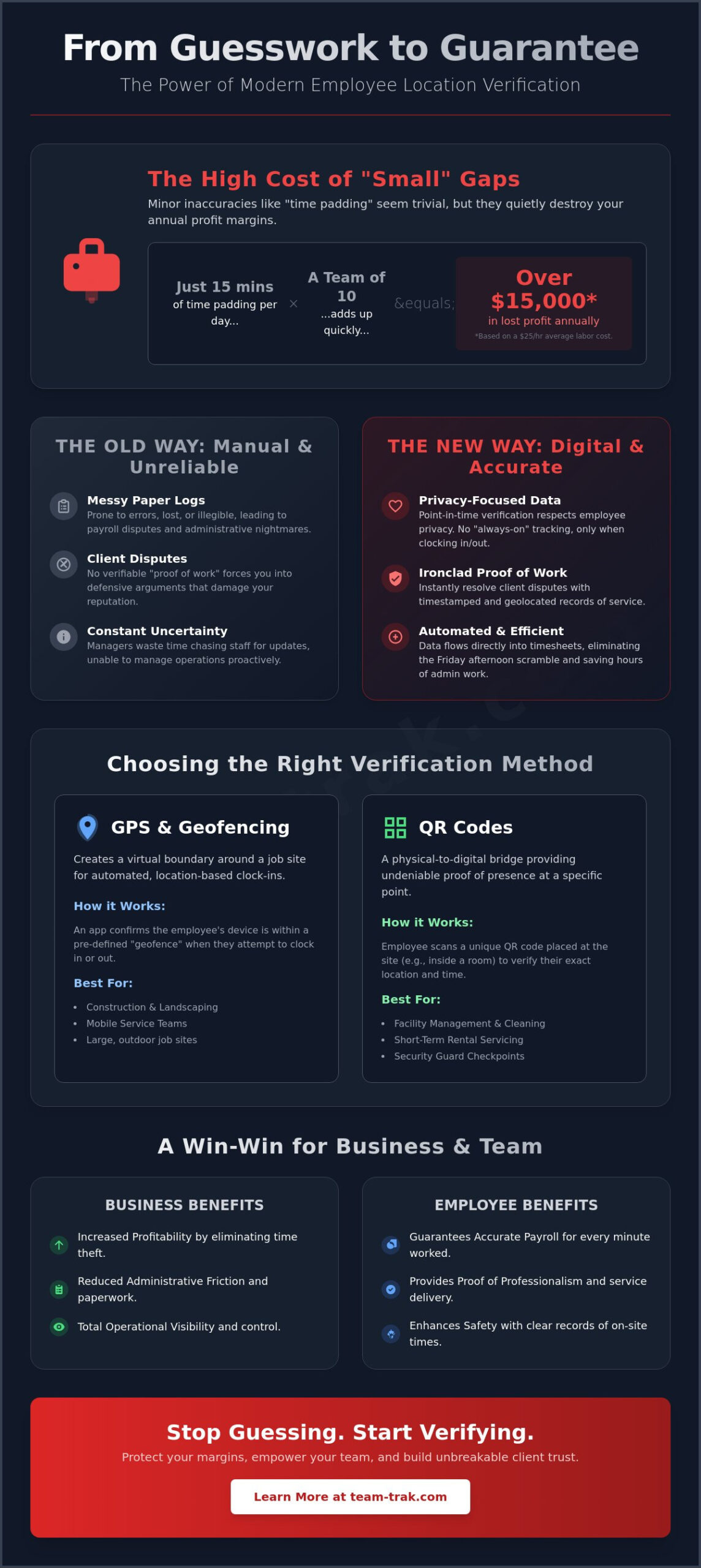
GPS vs. QR Codes: Choosing the Right Method for Your Team
The right verification method depends entirely on your operational needs. There is no one-size-fits-all answer, but a few simple questions can guide your decision.
- Industry & Site Type: Does your team work at large, open-air sites or in dense, multi-unit buildings?
- The “Micromanager” Test: Which method gives you the visibility you need without making your staff feel untrusted?
- Cost & Implementation: Are you more comfortable with a purely digital solution (GPS) or one that involves placing physical markers on-site (QR codes)?
- Reliability: How strong is the GPS signal at your typical client locations?
Best for Trades and Construction
For large, outdoor job sites, GPS verification is almost always the best choice. When managing teams across sprawling construction projects or multiple landscaping locations, a geofence provides the perfect boundary for accurate clock-ins. It gives you the high-level visibility needed to confirm your construction and trades teams are on-site without needing to track them to a specific room.
Best for Cleaning and Short-Term Rentals
For businesses that service multi-unit buildings, QR codes are superior. A geofence can confirm a cleaner is at the right apartment complex, but a QR code confirms they are inside Unit 2B. This level of precision is essential for short-term rental hosts and commercial cleaning companies, where you can combine a QR scan with a digital task checklist for total quality control.
Implementing Verification Without Damaging Staff Trust
Introducing any new system requires clear communication. The key is to frame location verification as a tool that benefits everyone, not just management. Adopting a “Partner, Not Police” approach is crucial for getting your team on board.
Explain the direct benefits to them:
- Accurate Pay: Digital records ensure they are always paid for every minute they work. No more forgotten hours.
- Dispute Protection: The system protects them from unfair client claims. It’s proof of their professionalism.
- Personal Safety: A digital check-in/out log provides a record of their whereabouts during work hours, which can be important for lone workers.
By setting clear boundaries—such as confirming that tracking never occurs outside of scheduled shifts—and providing simple training, the mobile app becomes a helpful tool, not a chore.
The Legal and Ethical Framework
Navigating privacy is straightforward when you are transparent. A clear, simple data policy that explains what information is collected and when is essential. Because “check-in only” systems are far less invasive than continuous monitoring, they are often more legally robust and easier for staff to accept. A good practice is to have staff sign a simple usage policy acknowledging they understand how the system works.
Scaling with Accountability
Ultimately, a location verification system allows you to manage more sites with greater confidence. It lets you transition from “checking on people” to “checking the system.” This shift frees up managers to focus on growth, training, and client relationships instead of spending their time verifying attendance.
With a reliable system in place, you can build a culture of accountability that empowers your team and gives you the operational visibility needed to scale effectively. It’s the foundation that helps you simplify your operations and build a more resilient business.
Frequently Asked Questions
Is an employee location verification system legal?
Yes, in most regions, it is legal to verify an employee’s location for work-related purposes like timekeeping, provided you are transparent about it. Policies should be clear, and tracking should be limited to work hours. Check-in/out systems are generally viewed more favorably than continuous, always-on tracking.
Can I track my employees when they are not on the clock?
No. A professional employee location verification system is designed to respect privacy and will only capture location data at the moment of clock-in and clock-out during scheduled work shifts. There should be no tracking during breaks or after hours.
What happens if a staff member has a poor GPS signal on-site?
This is a common issue in basements, large concrete buildings, or rural areas. It’s why flexible systems often include QR codes as a reliable alternative. If both fail, the system should allow for a manual entry that flags it for manager review and approval.
Do I need to buy expensive hardware for location verification?
No, modern systems are app-based and run on the smartphones your staff already own. This eliminates the need for investing in and maintaining expensive proprietary hardware.
How do I explain location tracking to my staff without sounding like a micromanager?
Focus on the mutual benefits. Frame it as a tool for ensuring fair and accurate pay, protecting them from client disputes, and streamlining administrative tasks for everyone. Emphasize that it is not about surveillance but about professionalism and accountability.
Is geofencing better than QR code check-ins for cleaning businesses?
It depends on the site. For a single, large commercial building, a geofence is great for verifying arrival. For a residential building with many different apartments, QR codes are better because they provide room-specific verification, ensuring the cleaner is at the correct unit.

Disclaimer
The information provided in this article is for general informational purposes only and reflects the opinions and experiences of the author. While every effort has been made to ensure accuracy, Team Trak makes no guarantees regarding completeness