You’re staring at an email from a frustrated client claiming your team arrived two hours late, but your technician insists they were on site by eight. Without clear proof, you’re stuck in a loop of “he said, she said” that usually ends with you losing money just to keep the peace. It’s a common headache for service business owners who feel buried under manual timesheet errors and fragmented communication. You shouldn’t have to spend your evenings playing detective just to verify a day’s work. When you establish a reliable team track process, that administrative friction starts to disappear.
We know you want a way to manage your field operations without adding more hours to your office schedule. Most owners accept these disputes as an unavoidable part of the job, but they don’t have to be. This article explains how to simplify your site visits, eliminate attendance disputes for good, and create a seamless flow from the job site to the final invoice. We’ll look at how to gain total operational visibility and the peace of mind that comes with knowing exactly where your team is, all without the stress of old-school manual logs.
Key Takeaways
- Identify the hidden costs of manual attendance logs and why generic scheduling tools often fail in the field.
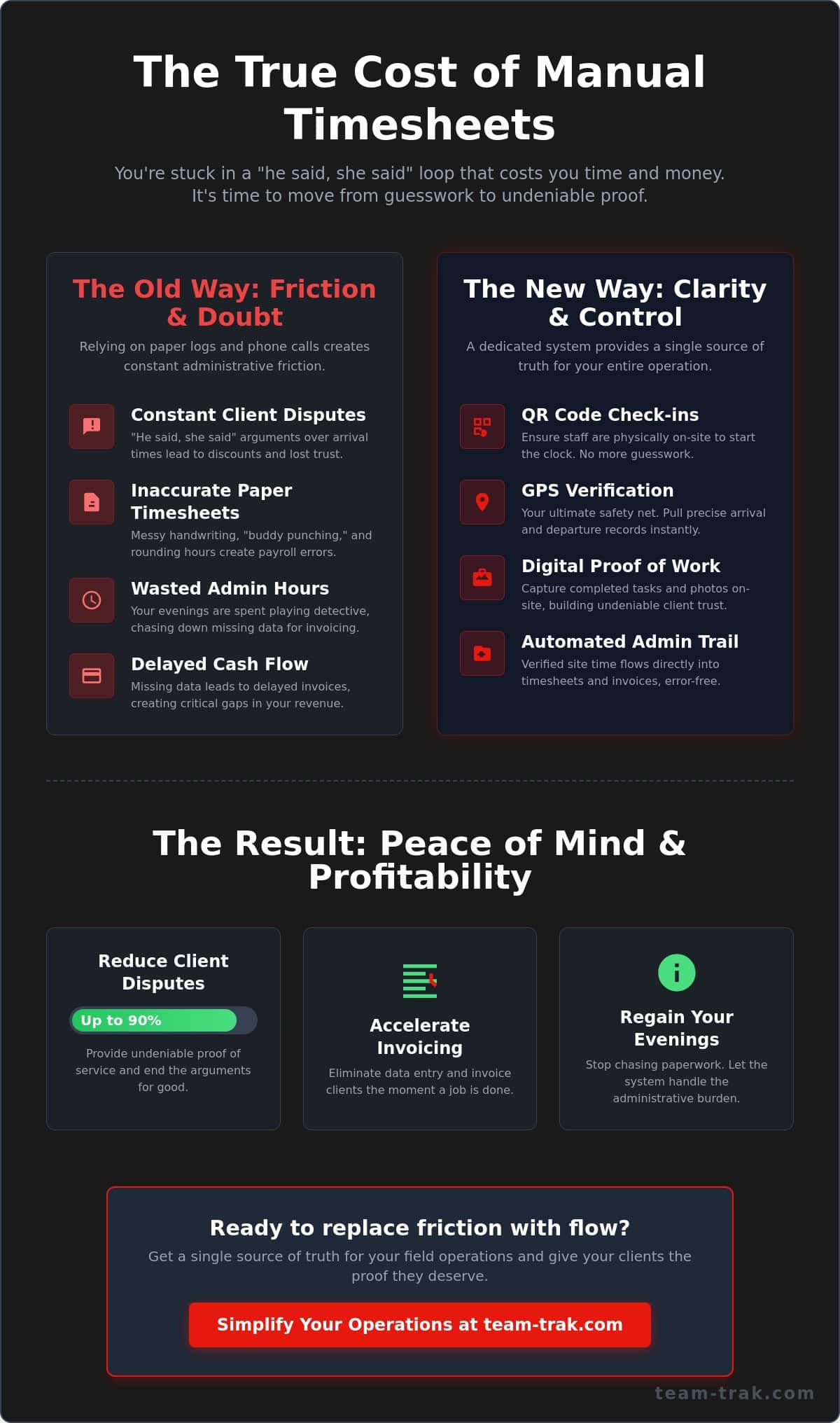
- Learn how to use QR code check-ins and GPS verification to provide undeniable proof of service for every client.
- Discover how to automate your administrative trail by converting verified site time directly into accurate timesheets and invoices.
- See how implementing a practical team track system can reduce client disputes by up to 90% and give you back your evenings.
Beyond the Spreadsheet: Why Service Teams Need a Dedicated Operational Track
Spreadsheets are great for accounting, but they’re a nightmare for managing people in the field. If you’re still relying on manual logs or “check-in” phone calls, you’re likely losing hours every week to administrative overhead. Generic scheduling tools often treat your team like static appointments on a calendar. They don’t account for the reality of traffic, site delays, or the simple human error that comes with paper timesheets. Establishing a dedicated team track gives you a reliable pulse on your business without the need for constant phone check-ins. It moves your office from a state of “I think they’re there” to “I know they’re there.”
Modern Field service management (FSM) focuses on bridging the gap between the office and the job site. For growing companies, this isn’t about complex technology for the sake of it. It’s about having a grounded framework that supports your team while they’re away from the desk. Team-Trak was built to simplify operations by removing the guesswork from daily management.
The Friction of Manual Management
Friday afternoons shouldn’t feel like a crime scene investigation. When you have to scramble for missing paper timesheets or decipher messy handwriting, your entire business slows down. Missing data leads to delayed invoicing, which creates immediate gaps in your cash flow. In simple terms, operational friction is the gap between work done and work recorded. Every minute your staff spends trying to remember when they arrived at a site is a minute they aren’t focused on the job. This manual burden doesn’t just frustrate you; it wears down your best employees, too. If you’re looking for a practical way to address this, understanding how to streamline field service operations software and dispatching can be the first step toward reclaiming those lost hours.
Visibility Without the Micro-Management
Most business owners hate micro-managing, but they also hate being in the dark. A central platform provides a single source of truth for everyone. You can give your staff the autonomy they need to do their jobs while you maintain the oversight required to protect the company. Visibility is a tool for support, not just surveillance. When you can see a team member is stuck at a site longer than expected, you can adjust the schedule before it becomes a problem for the next client. It creates a professional environment where accountability is built into the system, allowing the office to breathe and the field team to focus on their craft.
Field Operations in Focus: GPS and QR Verification in Action
How often do you find yourself apologizing to a client for a late arrival you can’t actually verify? These awkward conversations happen because without undeniable proof, the client’s word always wins. Building a reliable team track isn’t about checking up on people. It’s about having their back with data that proves they were where they said they were, doing exactly what they were paid to do. When you move away from verbal confirmations and toward digital verification, you protect your reputation and your profit margins at the same time.
The Mechanics of Proof
The most effective way to eliminate “buddy punching” and attendance fraud is through QR code tracking on-site. By placing a unique code at the client’s location, you ensure that staff must physically be present to check in. This simple step removes the temptation for manual errors or rounding up hours. It’s a quiet, non-confrontational way to ensure accountability across the board.
When questions do arise, GPS verification acts as your ultimate safety net. If a client claims a visit was skipped, you can pull up a precise record of the arrival and departure times. This doesn’t just resolve disputes; it also provides an extra layer of safety for lone workers in the field. Knowing the office has a record of their location gives staff peace of mind while they focus on the task at hand.
Standardising the Service Quality
Visibility goes beyond just knowing your team arrived. It’s also about knowing the job was finished to your specific standards. Through the mobile staff app, your team can follow task management checklists that guide them through every step of the service. This ensures that nothing is missed, whether it’s a specific cleaning requirement or a safety check on a construction site. Capturing this data in real-time means the office sees exactly what’s happening without making a single phone call.
Proof of work is the most powerful marketing tool a service firm can have. When you can send a client a report showing exactly when your team arrived, the tasks they completed, and when they left, you build a level of trust that “old school” competitors simply can’t match. It turns your daily operations into a transparent, professional experience that clients are happy to pay for. If you’re ready to see how these tools fit into your specific workflow, you can reach out to our team for a practical look at the platform.
From Field to Finance: Automating the Admin Trail
Verification in the field is only half the battle. If you’re still manually typing those hours into a billing system at the end of the week, you’re just moving the bottleneck from the job site to your office desk. A robust team track system connects these two worlds. It ensures that every minute spent on site is captured and moved toward your bank account without manual intervention. This is where operational visibility turns into actual profit.
Ending the Timesheet Headache
Manual timesheets are a breeding ground for errors. Whether it’s staff “rounding up” to the nearest hour or simply forgetting to log a site visit, these small discrepancies add up to significant costs over a year. By using automated timesheets, the system handles the heavy lifting for you. It calculates standard shift hours and overtime based on the actual GPS and QR data collected on-site. Based on industry efficiency reports, managers who automate these calculations save an average of 4 hours of admin per week. You’re no longer the middleman between a scrap of paper and a payroll system; you’re just the person who hits “approve.”
Closing the Invoicing Gap
Cash flow is the lifeblood of any service business. When you wait until the end of the month to tally up site visits and send invoices, you’re essentially giving your clients interest-free loans. Team-Trak allows you to turn a finished task into a sent invoice in minutes rather than days. Because the platform links directly to online accounting systems, you don’t have to worry about the double-entry trap where data gets lost between different apps.
Simplifying operations in this way means you can focus on growing the business rather than chasing paperwork. It provides a quiet, “done for you” administrative trail that keeps your finances as organized as your field team. You get the relief of knowing that every job is accounted for, every hour is billed, and every invoice is accurate. If you want to see how this flow works for your specific industry, you can book a practical walkthrough with our team today.
Regaining Control: Why Practical Founders Choose Team-Trak
Founders in labor-intensive industries don’t usually care about technology for its own sake. They care about results. They want to know that when they aren’t on-site, the work is still being done correctly. For many trades and field service companies, the pivot to a digital system isn’t about following a trend; it’s about survival and sanity. One cleaning firm recently reported that they reduced client disputes by 90% simply by having a verifiable record of their team’s presence. When you have that kind of data in your pocket, the stress of the “unknown” simply evaporates.
Choosing a team track system shouldn’t feel like you’re hiring an IT department. Most enterprise-level tools are over-engineered for the needs of a small or medium service business. They come with steep learning curves and fees that don’t always match the value they provide. Practical founders choose grounded tools because they want to solve specific problems: Did they arrive? Did they finish the task? Can I bill for it now? By focusing on these core operational needs, you can get started without the headache of a massive setup process. If you’re still unclear on what separates a purpose-built solution from a generic tool, our guide on what is field service management software breaks down exactly what to look for as a service operator.
Designed for Real-World Service
The platform feels different because it was designed by people who have actually managed teams in the field. It prioritizes the three things that keep a business running: arrival verification, task completion, and accurate billing. You don’t need to navigate through ten different menus to find out if your crew showed up. Everything is visible at a glance. The interface is built for the operator who needs to make quick, informed decisions without getting lost in unnecessary features or corporate jargon.
The Path to Operational Excellence
Total visibility is the foundation for scaling. You can’t grow a business if you’re stuck in the office putting out fires or mediating disputes over arrival delays. When your operations are quiet and automated, you finally have the mental space to look at the big picture. You move from reactive management to a proactive state where you’re making decisions based on data rather than gut feelings. The goal isn’t just better software; it’s about reclaiming your time and building a company that can run smoothly without you being involved in every single detail.
Take Back Your Time with Operational Clarity
Running a service business shouldn’t mean spending your weekends reconciling paper logs or arguing over arrival times. By moving toward a digital system, you replace administrative stress with undeniable proof of service. You’ve seen how GPS-verified attendance tracking protects your reputation and how direct links to your accounting software can save hours of manual entry every week. Establishing a reliable team track isn’t just about oversight; it’s about building a foundation that lets you scale without the weight of legacy manual processes holding you back.
The transition doesn’t require a complex enterprise setup. You can start small, focus on the core operational needs of your field team, and see immediate relief in your daily administrative load. When your operations are visible and your billing is automated, you finally have the mental space to focus on growing your business. Start simplifying your field operations with Team-Trak today and regain the control you need to lead with confidence. You’ve built a great business, and now it’s time to let it run with the precision it deserves.
Frequently Asked Questions
Is Team-Trak suitable for very small teams of 2-3 people?
Yes, the platform is specifically designed to be accessible for teams as small as two or three people. Many small service businesses start with manual logs because they think software is only for larger firms, but the time saved on admin is just as valuable for a small crew. The flexible monthly subscription means you only pay for the users you actually have, allowing your operational costs to stay proportional to your revenue.
How does the QR code check-in prevent staff from scanning from home?
The system prevents fraudulent check-ins by combining the QR code scan with GPS location verification. Even if a staff member somehow had a copy of the QR code at home, the app checks their physical coordinates against the site geofence. If they aren’t within the correct radius of the job site, the check-in won’t be verified. This dual layer of security ensures your records remain accurate and your reputation stays protected.
Does Team-Trak work offline if my team is in a poor signal area?
Yes, the platform is built to handle the realities of field work, including poor signal areas. The mobile staff app records check-ins, check-outs, and task completions locally on the device while offline. Once the technician moves back into an area with a stable internet connection, the data automatically syncs with the main office dashboard. You won’t lose any records just because a job site is in a basement or a remote location.
Can I link Team-Trak to my existing accounting software like Xero or QuickBooks?
You can absolutely link the platform to your existing online accounting systems like Xero or QuickBooks. This integration is a core part of the team track workflow, as it allows you to move directly from a verified site visit to a draft invoice. By removing the need for manual data entry, you eliminate the common transcription errors that often lead to billing disputes and delayed payments from your clients.
What industries benefit most from using the Team-Trak platform?
Any business that manages a mobile workforce on client properties will see significant benefits. This includes trades like plumbing and electrical, commercial cleaning firms, construction crews, and short-term rental managers. These industries often struggle with fragmented communication and manual timesheet errors. The platform provides the necessary team track for distributed crews without requiring constant phone calls or heavy office based oversight.
How much time does it typically take to set up the staff app?
Setting up the staff app typically takes less than five minutes per person. Your team simply downloads the app from the standard app stores and logs in with the credentials you provide. There is no complex enterprise configuration or hardware to install. Because the interface is designed for operators rather than tech experts, most field staff can begin using the QR check-in and task checklists on their very first day.

Disclaimer
The information provided in this article is for general informational purposes only and reflects the opinions and experiences of the author. While every effort has been made to ensure accuracy, Team Trak makes no guarantees regarding completeness