It is Friday afternoon. You are just about to finish your week when a client calls, frustrated. They claim your team left the site an hour early and missed several key tasks. You check your messages, but all you have is a vague “all done” text from your supervisor. You want to trust your staff, but without data, you are stuck in a defensive position. Since 74% of mobile workers report that customer expectations are higher than ever according to recent industry data, learning how to ensure service quality consistency is no longer just a goal. It is a survival requirement for your business.
We know the weight of that operational stress. It is the constant worry that a single missed corner or an early departure will cost you a long-term contract. You deserve a system that provides total visibility without the need for micromanagement. This article will show you how to move from hope-based management to a system of verifiable operational excellence. We will explore how to replace paper trails and messy WhatsApp groups with clear, digital evidence. You will learn how to use GPS verification and task checklists to provide the proof of service that eliminates client disputes before they even start.
Key Takeaways
- Identify the “visibility gap” that causes inconsistent results and learn why manual supervision often fails as your service business scales.
- Discover how to ensure service quality consistency by establishing a “Gold Standard” for both the physical work and the communication your clients expect.
- Replace messy WhatsApp groups and paper trails with digital guardrails that guide your staff through every specific task while they are on-site.
- Use GPS location verification to provide undeniable “proof of work,” turning potential client disputes into opportunities for professional transparency.
- Simplify your weekly administration and keep clients loyal by giving them direct access to real-time attendance logs and task completion photos.
Why Service Quality Consistency is the Ultimate Field Service Challenge
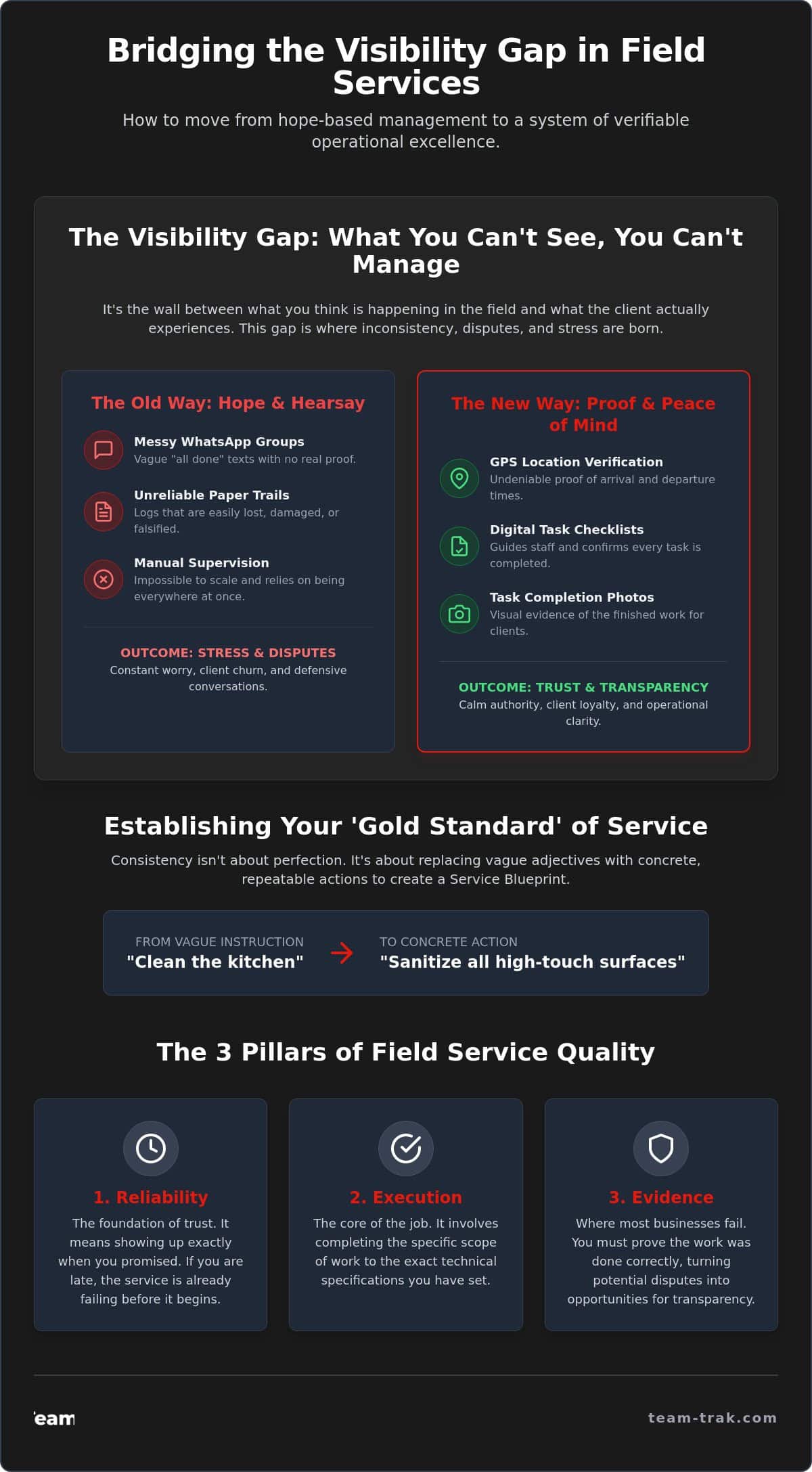
Service consistency is the ability to deliver the same result regardless of which staff member is on-site. If your client receives a different experience when “Dave” shows up compared to when “Sarah” does, you don’t have a system; you have a collection of individuals. This unpredictability creates the Visibility Gap. It is the wall between what you think is happening in the field and what the client actually experiences. Understanding how to ensure service quality consistency starts with acknowledging that you cannot manage what you cannot see.
The cost of this inconsistency is higher than most operators realize. It leads to client churn, constant refund requests, and the slow erosion of your brand reputation. In a competitive market, you aren’t just selling a service; you are selling reliability. This is where the core principles of Quality management become vital. You must move toward Operational Realism. This is the honest admission that manual systems, like paper logs or verbal check-ins, will eventually fail as your business grows. Relying on “good intentions” is not a scalable strategy.
The Invisible Workforce Problem
Many business owners rely on WhatsApp groups or paper logs to track their teams. These methods often create a false sense of security. A “job finished” text doesn’t tell you if the bins were emptied or if the staff left thirty minutes early. There is a specific psychological shift that occurs when staff know their work is being verified in real time. It isn’t about a lack of trust. It is about providing the clear, digital guardrails that simplify operation for everyone involved.
I have seen this play out many times during the Friday Afternoon Scramble. This is the period where staff, exhausted from the week and eager to start their weekend, begin cutting corners to finish their rounds. Without a system to verify task completion, your quality will inevitably dip during these high-pressure windows. When you don’t have proof of work, you are left defenseless when a client calls to complain about a missed task on a Monday morning.
Consistency vs. Perfection
You don’t actually need your team to be perfect every single day. Most clients would much rather have a predictable 8 out of 10 performance every week than a 10 out of 10 followed by a 4 out of 10 the next visit. Consistency is what builds brand equity for small service firms. It allows you to justify premium pricing. The client is happy to pay more because they are buying the peace of mind that the job will be done to your “Gold Standard” every time, without them having to micromanage your team for you.
Defining Your ‘Gold Standard’ for Field Operations
Setting a “Gold Standard” isn’t about chasing aimless perfection. It’s about being specific. I once managed a team where the instruction was simply “clean the kitchen.” One person wiped the counters; another scrubbed the grout. The client was confused because the result changed every week. To solve how to ensure service quality consistency, you must replace vague adjectives with concrete actions. Instead of “clean,” use “sanitize all high-touch surfaces.” This level of detail forms your Service Blueprint, mapping every touchpoint from the moment your van pulls up to the final invoice.
Your blueprint must account for both tangibles and intangibles. The tangibles are what the client sees immediately: clean uniforms, organized equipment, and the finished result. The intangibles are often more important for long-term loyalty. This includes how your team communicates, their punctuality, and the respect they show for the property. If your staff is technically brilliant but leaves muddy footprints on a beige carpet, the client won’t remember the quality of the work. They will remember the mess.
The 3 Pillars of Field Service Quality
- Pillar 1: Reliability. This is the foundation. It means showing up exactly when you promised. If you are late, the service is already failing before it begins.
- Pillar 2: Execution. This is the meat of the job. It involves completing the specific scope of work to the exact technical specifications you’ve set.
- Pillar 3: Evidence. This is where most businesses stumble. You might do the best job in the world, but if you can’t prove it to the client, you are still vulnerable to disputes. Evidence turns your work into a verifiable asset.
Standard Operating Procedures (SOPs) for Remote Teams
Standard Operating Procedures (SOPs) shouldn’t live in a dusty binder in your office. They need to be in your team’s pocket. As noted in these insights on Standard Operating Procedures (SOPs), consistency only happens when the “right way” is the easiest way to work. Using task management and checklists ensures that even your most “experienced” staff don’t skip steps on a busy Tuesday.
A common mistake is assuming veterans don’t need guidance. In reality, even pilots use checklists for every flight. It isn’t about a lack of skill; it is about reducing the mental load so they can focus on doing the job right. If you are tired of being the only person who knows how the job should be done, it might be time to see how digital systems can carry that weight for you.
Systems Over Supervision: Building Repeatable Workflows
Supervision is a trap. If your business only runs well when you are looking over someone’s shoulder, you don’t have a scalable operation. You have a job that depends on your presence. To solve how to ensure service quality consistency, you have to move away from active supervision and toward digital guardrails. These are systems that make the right way of doing things the only way of doing things. It’s about building a workflow that produces quality by default, not by luck.
A major part of this is workforce management scheduling. When your team is overbooked or routes are poorly planned, quality is the first thing to suffer. Rushed staff cut corners. By creating realistic, data-driven schedules, you prevent the burnout that leads to sloppy work. It’s about setting your team up for success before they even leave the house. You can’t expect an 8/10 result from a staff member who has been pushed into a 12-hour day with no breaks.
We also need to talk about accountability. Transitioning to automated timesheets does more than just stop “time padding.” It provides “Proof of Work.” This protects your staff from unfair client claims just as much as it protects your bottom line. If a client says a cleaner didn’t show up, but you have a GPS-verified check-in, the dispute ends instantly. That clarity brings a sense of calm to the entire team.
Digital Checklists: The End of ‘I Forgot’
New staff can be trained up to 50% faster when they have a mandatory digital checklist. They don’t have to memorize every detail of a construction site or an Airbnb turnover; the app tells them exactly what to do next. By making these lists mandatory for clocking out, you ensure nothing is missed. Digital checklists serve as the essential bridge between your expectations and the reality of field execution.
Reducing Administrative Friction
Manual data entry is a hidden killer of morale. If your best supervisors are spending three hours every Friday night reconciling paper logs and chasing “missing” hours, they will eventually quit. Using field service tracking software automates the boring stuff. When you reduce that administrative stress, your team has more mental energy to focus on actual customer service and high-quality work. Operational excellence happens when your people aren’t buried in paperwork.
Verification vs. Micromanagement: Bridging the Visibility Gap
Micromanagement is a slow poison for any service business. It burns out managers and insults the intelligence of your best staff. However, the Visibility Gap still exists. You need to know the work is being done without calling your team every twenty minutes. The secret to how to ensure service quality consistency lies in shifting the conversation from “watching them” to “verifying the service.” When you frame tracking as “Proof of Service” for the client, it stops being about suspicion and starts being about professional standards.
Using GPS location verification and QR code check-in and check-out provides undeniable attendance data. This isn’t just for your benefit. It actually creates a much fairer workplace for your high-performers. In many businesses, the staff who cut corners often get away with it, while your best people carry the load. Verification data exposes the laggards and highlights the heroes. It ensures your top talent feels seen and appreciated because their hard work is finally documented.
The Psychology of Accountability
Passive tracking is far more effective than active supervision. It sits in the background, providing a safety net of data. One cleaning business owner I know used this exact data to win back a major client who was ready to cancel. The client claimed the team hadn’t visited the site for two weeks. The owner pulled the GPS reports, showing the exact arrival and departure times for every scheduled visit. The dispute was settled in five minutes, and the client stayed. Data doesn’t just punish mistakes; it rewards consistency by proving the work was done.
Proof of Work as a Competitive Advantage
Every operator eventually realizes that you can’t be everywhere at once. Learning how to ensure service quality consistency through data rather than physical presence is the only way to scale without losing your mind. When you are pitching for a new contract, your competitors will all say the same thing: “We have the best people.” It is a tired, unverifiable claim. You can do better. Tell your clients exactly how you verify quality. Explain that you use GPS and QR verification to guarantee attendance.
This is a much stronger USP because it offers the client peace of mind based on facts, not promises. You can even include verification reports in your monthly updates to show them exactly what they are paying for. It builds a level of trust that “old school” businesses simply cannot match. If you want to bridge the visibility gap in your own business and protect your reputation, see how our verification tools can help you scale.
Closing the Loop: Using Transparency to Prove Quality
The final step in how to ensure service quality consistency is moving from internal tracking to external transparency. A Client Portal is the ultimate tool for this. It fundamentally changes the relationship you have with your customers. Instead of them calling your office to ask if a technician arrived, they can log in and see the evidence themselves. You are providing them with real-time access to attendance logs and task completion photos. This proactive approach is much more effective than waiting for a complaint to trigger a reactive investigation. It shows you have nothing to hide.
This level of transparency significantly reduces the “Inquiry Load” on your office staff. Think about the hours your team spends every week answering basic questions. “Where is my technician?” “Did the cleaner finish the kitchen?” When the data is available to the client, those calls disappear. Your administration becomes quieter and more focused. Team-Trak acts as the bridge between your field team’s hard work and your client’s high expectations. It turns your operational data into a customer service asset.
Building Trust Through Data
Clients stop questioning invoices when they have access to the data. It’s a simple truth of the service industry. For trades and field service companies, this level of detail is a massive retention tool. It makes your business indispensable because you provide a level of certainty that competitors cannot match. If a client ever does raise a concern, you can handle it with “Calm Authority.” You don’t have to guess or get defensive. You simply pull up the evidence. If a task was missed, you own it and fix it instantly. If it was done, you show the proof and move on.
Your Next Steps for Operational Excellence
Your first task is to audit your current “Visibility Gap.” Where are you flying blind right now? Identify the specific sites or team members where you have the least clarity. Then, start a 30-day plan to transition from paper logs to digital verification. Don’t try to change your entire business in one afternoon. Start with one problematic site or one specific team to prove the concept.
Use QR code check-in and check-out for your most remote sites first. You will see an immediate difference in staff accountability and client peace of mind. Once that is stable, roll the system out to the rest of your operation. Learning how to ensure service quality consistency isn’t a mystery; it’s a choice to use better systems. Consistency is the only way to scale your business without losing your mind in the process.
Take Control of Your Operational Standards
Scaling a service business shouldn’t mean losing sleep over what your team is doing in the field. You’ve learned that how to ensure service quality consistency isn’t about hiring perfect people; it’s about building a system that makes excellence the default. By replacing vague instructions with digital checklists and verifying attendance with data, you close the visibility gap that causes client churn and administrative headaches.
Moving from paper logs to a digital “Proof of Work” engine gives you the evidence needed to win disputes and protect your reputation. You deserve the peace of mind that comes from knowing every site visit is documented and every task is completed to your standard. When you provide clients with transparency through a dedicated portal, you aren’t just selling a service; you are selling reliability.
Stop the ‘Friday Afternoon Scramble’ and start verifying your service quality with Team-Trak today.
Our platform provides GPS-verified attendance for absolute clarity, QR code check-ins for site-specific accountability, and integrated client portals that build lasting trust. You have worked too hard to let inconsistent service hold your growth back. It’s time to build a business that runs like clockwork, even when you aren’t there to watch it.
Common Questions About Service Consistency
How do I explain GPS tracking to my staff without sounding like I don’t trust them?
Frame GPS tracking as a tool for “Proof of Service” that protects the staff member from unfair client claims. If a customer disputes a visit, the GPS data is the employee’s best friend; it provides undeniable evidence that they were on-site and doing their job. It isn’t about watching their every move. It is about having their back when a dispute arises.
Is service quality consistency possible for a small business with only 5 employees?
Consistency is actually easier to implement when your team is small because you can set the “Gold Standard” early. If you want to know how to ensure service quality consistency as you grow, starting with five employees is the perfect time to build your digital guardrails. It ensures that your very first clients receive the same high-quality experience as your hundredth.
What is the difference between service quality and service consistency?
Service quality is the high bar you set for the work, while consistency is your ability to hit that bar every single time. You can have high quality on a Tuesday but fail on a Thursday if your systems are weak. Understanding this distinction is vital for how to ensure service quality consistency because it moves your focus from individual talent to repeatable operational systems.
How much does it cost to implement a service tracking system?
The real cost to consider is the price of “not” having a system, which includes client churn, refund requests, and administrative friction. Most businesses find that the time saved on the “Friday afternoon scramble” more than covers the investment. You should look for a solution that offers a clear return on investment through reduced disputes and automated administrative tasks.
Can I use QR codes for construction sites or outdoor locations?
Yes, weatherproof QR codes are a standard tool for construction and outdoor field services. You can mount them on site gates, equipment, or entrance points to ensure site-specific accountability. They are durable enough to handle rain, dust, and heavy use while providing absolute attendance accuracy for your remote workforce.
What happens if a staff member forgets to check in via the app?
Digital systems allow managers to make manual corrections, but these gaps often highlight a training opportunity. If a staff member consistently forgets, it is usually a sign that the workflow isn’t fully integrated into their daily routine. You can use these instances to reinforce the habit, explaining that a missing check-in means you can’t prove their hard work to the client.
How do checklists help with high staff turnover in the cleaning industry?
Checklists act as “on-the-job training” that allows new hires to be productive from day one. In the cleaning industry, where turnover can be high, digital checklists ensure that a new staff member follows the exact same steps as a veteran. They don’t have to guess what “clean” means; the app tells them exactly which surfaces to sanitize before they can clock out.
Does field service management software integrate with Xero or QuickBooks?
Yes, the platform links directly to online accounting systems to eliminate manual data entry. This integration allows you to sync attendance data and task completion logs with your invoicing and payroll tools. It removes the stress of reconciling paper timesheets and ensures that your billing is always based on verified “Proof of Work” data.

Article by
Bob Fitzjohn
Bob Fitzjohn
Founder of Team-Trak and serial entrepreneur with over 50 years’ experience building and scaling service businesses. Bob writes about workforce management, operational efficiency, automation, and the realities of running small businesses in today’s environment.
Disclaimer
The information provided in this article is for general informational purposes only and reflects the opinions and experiences of the author. While every effort has been made to ensure accuracy, Team Trak makes no guarantees regarding completeness