
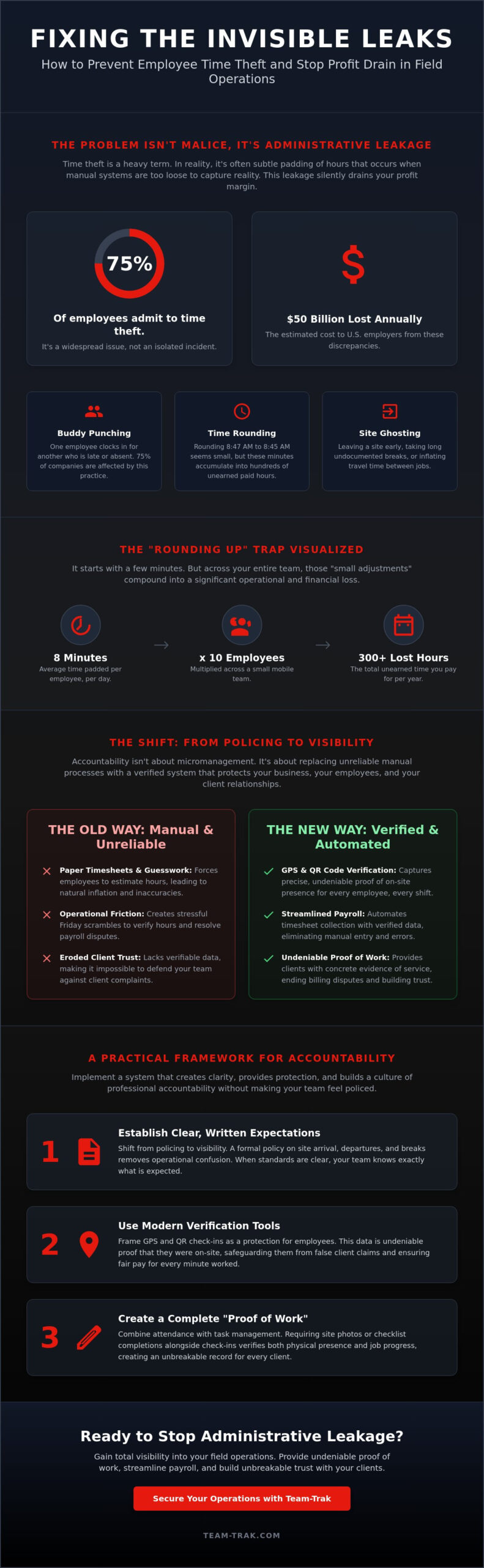
Did you know that 75% of employees admit to stealing time from their employers at least once? In field operations, this rarely looks like a grand heist. It usually looks like 15 minutes of “rounding” per shift or a long lunch that isn’t recorded. Learning how to prevent employee time theft is not about being a micromanager; it’s about fixing the invisible gaps where your profit margin is leaking away.
You probably recognize the Friday afternoon scramble to verify manual timesheets against a calendar that doesn’t quite match. It’s stressful to defend your team to a client who claims nobody was on-site when the paperwork says they were. You want to trust your people, but you also need to know that the hours you’re paying for are actually being spent on the job.
This guide will show you how to eliminate administrative leakage and build a culture of accountability using proven operational strategies and modern verification tools. We’ll walk through how to gain total visibility into site attendance and reduce payroll costs through accurate data. By the end, you’ll have a clear roadmap to provide undeniable proof of work for every client you serve.
Key Takeaways
- Understand why administrative leakage is more than just a rounding error and how to spot the three most common forms in field service operations.
- Move from a culture of policing to one of visibility by establishing clear, written expectations for site-based staff.
- Discover how to prevent employee time theft by replacing unreliable paper logs with GPS location verification and mobile staff apps.
- Streamline your payroll process by using verified attendance data to eliminate manual entry errors and the Friday afternoon scramble.
- Build stronger client trust by providing undeniable proof of work for every shift, ensuring billing is always accurate and undisputed.
Understanding the Real Cost of Administrative Leakage
Time theft is a heavy term that often suggests malicious intent. In field operations, it’s more accurate to call it “administrative leakage.” This is the subtle padding of hours that occurs when your systems are too loose to capture reality. Whether it’s an intentional choice or a byproduct of a messy manual process, the result is the same: you’re paying for time that wasn’t worked. U.S. employers lose an estimated $50 billion annually to these discrepancies. For a service business, this is an operational drain that kills your margins.
Common forms of this leakage include “buddy punching,” leaving a site early, or inflating travel time between jobs. Research shows that 75% of companies have been affected by buddy punching, where one employee clocks in for another. When you rely on manual paper timesheets, you’re essentially asking your team to guess what happened several days ago. This lack of precision is the primary hurdle for owners trying to learn how to prevent employee time theft effectively. While it falls under the broader umbrella of Understanding Wage Theft, for you, it’s about lost service capacity and vanishing profit.
The “Rounding Up” Trap
It starts small. A technician rounds 8:47 AM to 8:45 AM. Then they round 4:10 PM to 4:15 PM. That’s 8 minutes of unearned pay. If you have 10 employees doing this daily, you’re losing over 300 hours of productivity a year. Manual systems force employees to estimate. Without a hard data point, people naturally inflate their hours to ensure they aren’t “shorted” on their paycheck. Moving from estimation to verification creates a psychological shift. When the time is recorded automatically, the temptation to “round” simply disappears.
Impact on Client Reputation
The cost isn’t just financial; it’s about your reputation. If a client checks their security cameras and sees your team arrived 20 minutes later than the invoice states, trust evaporates instantly. This “ghosting” of sites leads to frustrating disputes that take hours of your time to resolve. Accountability shouldn’t feel like an attack on your staff. Instead, it’s a tool to provide proof of work to your customers. Having verifiable data means you never have to guess when a client calls with a complaint. You have the facts, and you have the peace of mind that comes with them.
Building a Foundation of Operational Accountability
Creating a culture of accountability isn’t about looking over shoulders or being a “Big Brother” figure. It’s about removing operational confusion. When you’re figuring out how to prevent employee time theft, the first step is shifting from a mindset of policing to one of visibility. If your team doesn’t have clear, written expectations regarding site arrival and departure times, they’ll naturally create their own standards. Establishing a formal policy is a critical component of Preventing Time Theft across a mobile workforce.
Instead of just paying for “hours worked,” start incentivizing accuracy and task completion. When employees know that their time on-site is being documented alongside the quality of their work, the temptation to pad hours diminishes. This approach builds trust because it rewards the people who are actually doing the job correctly. It turns time tracking from a chore into a standard part of a professional workflow.
The Transparency Agreement
The biggest hurdle to new verification tools is often staff pushback. You can minimize this friction by framing digital check-ins as a protection for the employee. If a client claims a cleaner never showed up, GPS data is the undeniable proof that protects that worker’s reputation. It ensures everyone is paid fairly for every minute they spend on-site. When the team understands that these tools eliminate “your word against theirs” disputes, adoption becomes much smoother. If you want to see how this looks in practice, you can chat with our team about your specific workflow.
Defining “Proof of Work”
A simple timestamp tells you when someone arrived, but it doesn’t tell you what they did. To truly secure your operations, you should combine attendance with task management and checklists. This creates a complete “proof of work” package for every shift. By requiring site photos or QR code scans at specific locations within a facility, you verify physical presence and progress simultaneously. This level of detail makes it nearly impossible to “stretch” a job or claim time for work that wasn’t completed. It provides the visibility you need to run your business with total confidence.
Practical Solutions: GPS and QR Verification
Most advice on how to prevent employee time theft focuses on office workers scrolling through social media. In field operations, your challenges are different. You’re dealing with early departures, extended lunch breaks, and the logistical nightmare of “buddy punching.” To stop the bleed, you need to replace “honor system” paper logs with a system that creates a digital breadcrumb trail. Implementing a dedicated mobile staff app is the first step toward operational excellence. This transition allows you to follow a clear sequence of verification steps:
- Step 1: Replace paper logs with a mobile staff app to eliminate manual data entry and “rounding.”
- Step 2: Implement GPS location verification for all clock-in and clock-out events.
- Step 3: Use QR code check-ins for high-security areas or multi-unit sites where GPS alone isn’t precise enough.
- Step 4: Set up automated alerts so you’re notified immediately of late arrivals or early departures.
Following these steps provides a framework for how to prevent time theft without needing to hover over your team. It replaces administrative friction with clear, data-backed results.
How GPS Location Verification Works
There’s a significant difference between constant “tracking” and “point-of-entry” verification. Constant tracking can feel invasive and drain phone batteries, often leading to staff pushback. Instead, GPS verification focuses only on the moment a worker starts or ends their shift. It logs their coordinates at check-in to ensure they’re actually at the job site before the clock starts running. This approach respects employee privacy while giving you the visibility you need to run a profitable operation. It’s a fair, transparent way to verify attendance without the “Big Brother” baggage.
The Power of QR Code Check-Ins
In certain environments, like large apartment complexes or indoor facilities, GPS signals can be imprecise. This is where QR code tracking becomes vital. By placing a unique QR code inside a specific room or utility closet, you require the staff member to be physically present at that exact spot to check in. This effectively eliminates buddy punching, as the worker must have their phone in front of the code to register their arrival. For the best results, place your codes in high-traffic areas or secure zones that technicians must visit to begin their tasks. This simple physical anchor removes the guesswork from your payroll.
If you’re ready to stop the “Friday afternoon scramble” and start seeing exactly where your labor budget is going, contact us today to see these tools in action.
Automating Accuracy to Streamline Payroll
Verification is only half the battle. If your attendance data stays trapped in a mobile app, you still have a manual data entry problem at the end of the week. When you’re looking at how to prevent employee time theft, the final goal is to ensure that verified data flows directly into your payroll without being touched by a human hand. This is where automated timesheets become your most valuable administrative tool. By removing the need for staff to manually record their hours, you eliminate the natural inflation and “rounding” that occurs when people are forced to guess their start and end times.
This automation bridges the gap between field attendance and professional invoicing. It ensures that every minute you pay for is accounted for by a verified site visit. By stripping away the administrative friction of manual logs, you reduce the pressure on your office team and yourself. You stop being a data entry clerk and start being an operator who manages by exception rather than by exhaustion.
Ending the Friday Afternoon Scramble
Every business owner knows the stress of the Friday afternoon scramble. It’s that window of time spent chasing down missing paper logs, cross-referencing text messages, and trying to remember if a specific technician actually showed up on Tuesday morning. When you have a single source of truth, this chaos disappears. Automated systems flag discrepancies, such as an early departure or a check-in that happened outside the geofence, before they ever reach your payroll. You’ll spend less time on “he-said, she-said” disputes because the data is clear, timestamped, and undisputed.
Connecting Operations to Accounting
The real power of digital transformation is the link between site work and your bottom line. By linking to online accounting systems like Xero or QuickBooks, your verified time data moves seamlessly from the field to your ledger. This ensures your labor costs are accurately reflected in your margins for every single job. You aren’t just guessing if a contract was profitable; you have the data to prove it. This level of precision is the most effective way how to prevent employee time theft from quietly eroding your growth. Accuracy is the foundation of a scalable service business, giving you the peace of mind to focus on your next big project instead of auditing old timesheets.
Restoring Profit Through Operational Visibility
Managing a mobile team doesn’t have to feel like a constant battle against administrative leakage. You’ve seen how moving from a culture of policing to one of visibility can transform your daily operations. By replacing manual logs with GPS-verified attendance and QR code check-ins, you secure your site security and build undeniable trust with your clients. These tools don’t just track time; they provide the proof of work your customers demand while protecting your staff from unfair disputes.
Knowing how to prevent employee time theft is ultimately about removing the friction that leads to human error. When your verified data flows directly into your accounting software, the “Friday afternoon scramble” becomes a memory. You gain the peace of mind that comes from precise data and the freedom to focus on growing your business instead of auditing timesheets. This shift allows you to lead with confidence rather than suspicion.
Operational excellence starts with the right tools to support your team. You can protect your margins and prove your value to customers without the stress of constant monitoring. It’s time to trade operational confusion for data-driven results and a more professional workflow. You’ve built a great business; now give it the foundation it deserves to scale smoothly.
Quietly remove your operational headaches with Team-Trak
Frequently Asked Questions
Is GPS tracking legal for my employees?
GPS verification is generally legal in most jurisdictions when it’s used for legitimate business purposes during working hours. The key is to distinguish between constant surveillance and point-of-entry verification. Most field operators use these tools to confirm a worker is physically on-site only at the moment they clock in or out. You should always check your local and state labor laws to ensure your specific policy remains compliant with privacy regulations.
How do I introduce time tracking without upsetting my best workers?
Frame the new system as a tool for protection rather than a tool for monitoring. Explain that digital logs provide undeniable proof of work if a client ever disputes an invoice or claims a technician wasn’t present. When you show your team that these tools ensure they’re paid accurately and fairly for every minute worked, the “micromanagement” fear usually disappears. Transparency builds a culture of mutual respect.
What is the difference between “buddy punching” and general time theft?
Buddy punching is a specific type of fraud where one employee clocks in for another who isn’t actually present. General time theft is a broader category that includes padding hours, taking extended breaks, or leaving a site early while staying on the clock. Both contribute to administrative leakage. Learning how to prevent employee time theft requires a system that addresses both intentional fraud and unintentional rounding errors.
Can I use QR codes if my staff work in areas with poor mobile signal?
Yes, professional mobile apps are designed to handle variable connectivity in the field. The check-in data is typically captured locally on the device at the moment of the scan and then synced once the worker moves back into a service area. This makes QR codes a reliable physical anchor for sites like basement utility rooms or remote construction zones. It ensures you still have a verified record of attendance regardless of signal strength.
How much money can a small business save by preventing time theft?
Small businesses can save thousands of dollars annually by eliminating simple rounding errors that occur with manual logs. If an employee rounds up by just 15 minutes per shift, that cost adds up quickly across a full team and a year of payroll. By tightening these gaps, you aren’t just saving on wages; you’re also reducing the administrative time spent auditing timesheets. This is a critical step in how to prevent employee time theft from eroding your margins.
Does preventitive software integrate with my current accounting tools?
Effective systems link directly to your existing accounting platforms like Xero or QuickBooks. This connection allows your verified attendance data to flow straight into your payroll and invoicing modules without manual intervention. It removes the need for repetitive data entry, which is where most human errors and rounding discrepancies occur. This integration creates a streamlined, professional workflow that protects your profit margins and simplifies your end-of-week administration.

Disclaimer
The information provided in this article is for general informational purposes only and reflects the opinions and experiences of the author. While every effort has been made to ensure accuracy, Team Trak makes no guarantees regarding completeness